1920s women’s shoes were the first footwear designed to be seen rather than hidden. Hemlines had risen to the knee, and what covered the foot suddenly mattered as much as any hat or glove.
A single pair of T-strap heels could carry a woman through the Charleston at a speakeasy and still read as formal enough for the ballroom, yet the real shift was simpler: for the first time, a shoe was part of the outfit, not merely its foundation.
T-Strap Heels

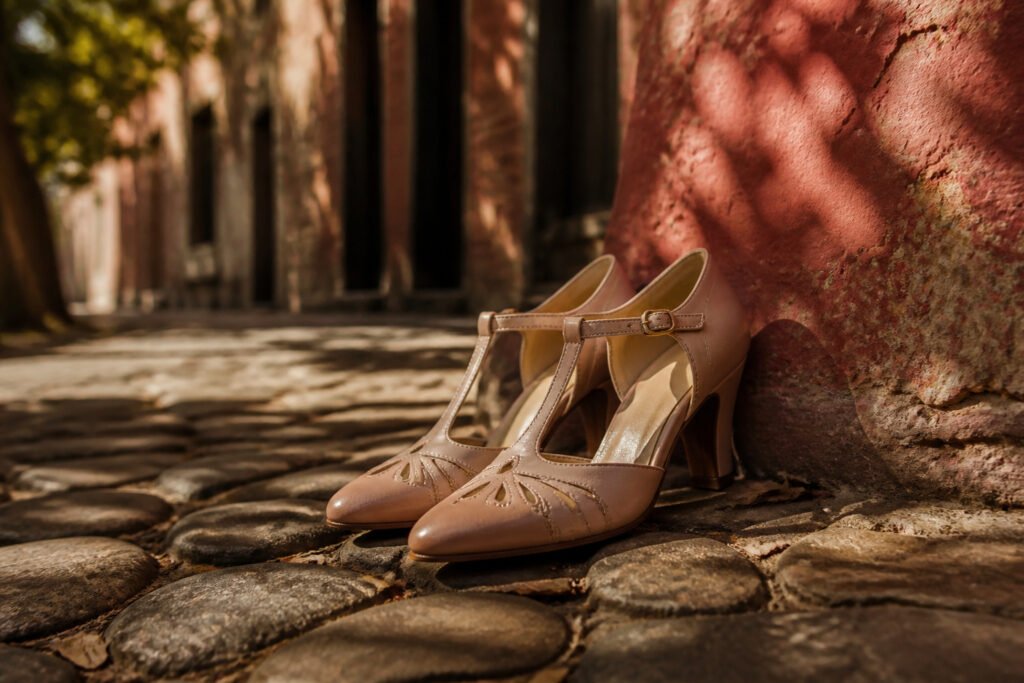
The T-strap heel earned its name from the single vertical strap that runs down the vamp and meets a horizontal ankle strap, forming that exact letter across the foot.
Most pairs sat on a low, curved heel, typically an inch and a half to two inches, which kept the wearer stable through quick steps.
I find the geometry telling: the strap anchors the foot at two points, so the shoe stays put without the full coverage of a lace-up.
This construction made T-strap heels natural allies of the flapper subculture.
Young women who were claiming public space, late hours, and social freedom needed footwear that could keep pace with the Charleston and the fox-trot. The T-strap delivered that mobility while still reading as formal enough for the dance hall.
By 1925, the color palette had shifted sharply from the sedate browns and blacks of earlier decades.
Bright color mixes, two-tone combinations, and metallic finishes peaked that year, turning the T-strap into something closer to jewelry than mere shoe. Black or metallic finishes remained the standard for evening, while lighter leathers handled daytime.
The toe box rounded gradually through the decade, moving from pointed early on to an almond shape by the late 1920s.
Mass production made this rounded form the norm, and it is the silhouette that reads as "1920s" to most eyes today. For period accuracy, skip the modern pointed-toe T-strap and go with an almond toe instead.
Mary Janes

The Mary Jane carried the 1920s through its daily routines with a single strap across the vamp and a low heel, usually around the modest 5 cm "Louis" heel height that kept a woman stable through a Charleston or a casual afternoon out.
That one strap did real work: it held the foot securely without the fuss of lacing up, and it sat right where shorter hemlines drew the eye, turning a practical closure into visible decoration.
Almond-shaped toes, rounded off from the sharper points of the decade’s early years, gave the Mary Jane a softer silhouette that read as feminine without tipping into fragility.
Straps multiplied on dressier versions, sometimes reaching a T-bar or even an ankle button, but the single-strap original stayed the workhorse.
Brogue detailing and cut-outs appeared on uppers, borrowing from menswear technique to add texture where everyone could now see it.
What I find telling is how the Mary Jane managed both sides of 1920s tension.
It was sensible enough for actual walking, yet it participated fully in the era’s new insistence that shoes be seen, matched, admired. Flappers adopted it for dancing; everyday women wore it to market.
The same shoe, barely altered, crossed those lines. That adaptability explains why comfort brands still mine it today, memory foam and all, though the originals needed no such help to earn their keep.
Oxfords

Lace-up construction gave 1920s women a shoe that stayed put through a full day, and the Oxford delivered it on a low military or Louis heel just high enough to keep hems from dragging.
Men’s Oxfords had been around for decades, but the Jazz Age recast them for women with slimmer lasts, decorative perforations, and the occasional two-tone pattern in dark brown or black leather and canvas.
The heel height marked the real divide: some sat at barely 1 inch, while later Cuban-heel variations added more lift. That measured evolution bridled the earlier menswear influence into something accepted as women’s everyday wear rather than borrowed costume.
By the time the decade closed, the Oxford had settled in as the practical day shoe that would carry straight through the 1940s, outlasting trendier rivals because it answered an actual need.
Saddle Shoes

Saddle shoes started out as men’s sporting shoes in the early 1900s, built for actual play rather than fashion.
The design that crossed into women’s wear kept the same two-tone construction: a white canvas body with a black leather "saddle" stitched across the middle, the contrast making the shoe read as sporty even when the wearer was not.
By the 1920s, women had taken them up in earnest. The flat version suited the decade’s new activities, the golf and tennis and general moving about that flapper-era life suddenly required.
Some makers added a slight Cuban heel to soften the look, a small concession to femininity that I find unnecessary but understand for the era.
The shoe works either way because the saddle itself, that dark leather patch, already gives it enough visual interest.
For a 1920s-styled outfit now, I’d pair them with a floral A-line dress and a cloche hat.
The combination reads casual and period-appropriate without costume-shop exaggeration. What I like about saddle shoes is their honesty: they never pretended to be dress shoes, and that straightforwardness made them adaptable across decades.
Lace-Up Boots

Lace-up boots in the 1920s covered the full foot with a delicate lace-up closure at the top, typically set on a 2.5-inch heel.
The style carried forward from the Edwardian decade and before, when boots were simply standard and hemlines hid them almost entirely.
What changed was the rise of the shorter skirt: once the ankle became visible, these boots adapted from purely practical footwear into something meant to be seen.
I find the timing telling. Mature women often stayed with lace-up boots through the decade, especially in winter, while younger women and flappers moved faster into T-straps and Mary Janes.
The boot itself was not exactly rejected; it was reclassified as conservative, even grandmotherly, against the new exposed-shoe look.
On a practical level, the full leather construction made lace-up boots the sound choice for all-weather wear, and they served as a direct alternative to open T-strap sandals when warmth or coverage mattered.
The same 2.5-inch heel height appeared across several 1920s shoe styles, so the elevation was not the differentiator; the full ankle coverage was.
If you are building a period wardrobe, I would use lace-up boots for autumn and winter scenes, or for a character whose age or temperament keeps her slightly behind the leading edge of fashion.
The detail matters because showing an ankle boot under a 1923 day dress reads quite differently than showing a strap sandal: one foot still partly in the old century, the other fully in the new.
Tennis Shoes

The flat lace-up canvas construction of 1920s women’s tennis shoes was simple by design: a rubber sole, cotton canvas upper, and laces pulled tight enough to keep the foot stable during a match.
Keds had already introduced its women’s tennis shoe in 1916, and by the 1920s the style had moved well beyond the court.
This shift marks one of the earliest examples of athletic wear becoming everyday wear, though sources don’t spell out exactly how fast or how far it spread.
Helen Wills wore these shoes as a tennis star of the era, which gave the style credibility with women who played seriously.
The Keds Champion Original kept the same basic silhouette, and the fact that it later showed up on Audrey Hepburn and Jackie Onassis tells me the 1920s version had already hit on a shape that didn’t need changing.
Canvas breathes better than leather, which mattered in longer matches, but it also stains faster and offers almost no water resistance.
For dry days and casual walking, that trade-off was acceptable enough that women started wearing them for errands, travel, and light outdoor activity.
The move from athletic to leisure happened without the shoe changing much.
The same flat sole and plain laces that worked for a backhand worked just as well for a Saturday afternoon. The 1920s didn’t invent the sneaker as streetwear, but it was the decade when women, specifically, made it normal.
Dancing Shoes

Satin and patent leather were the materials that mattered for dancing shoes in the 1920s, and the difference between them was practical, not just decorative. Satin uppers gave under stage lights; patent leather caught the flash of a ballroom chandelier.
Both sat on a rounded point toe that let a woman pivot without catching her heel, and the Louis heel, curved and set under the arch, was built for movement rather than display.
A T-strap or single button strap across the instep kept the shoe anchored through the Charleston’s high steps.
The straps buttoned at the side, and the button itself became a small stage: enamel, rhinestones, or brass covers turned a functional closure into the era’s jewelry.
The cut-away sides and flexible sole were the engineering that let a woman dance past midnight, while the diamante lines and Art Deco patterns announced that she had somewhere worth going.
These shoes sat at the crossing of two needs: the body had to move, and the body had to be seen moving. The 1920s made both possible in one object.
What Changed in 1920s Dress

Shorter hemlines in the 1920s did something no previous decade had managed: they made shoes visible. For centuries, women’s footwear stayed hidden beneath floor-length skirts, judged only by comfort and durability since no one but the wearer would see it.
Once hemlines rose to the knee, the shoe became part of the outfit, not merely its foundation.
This visibility carried real social weight.
The flapper subculture, young cosmopolitan women who embraced the era’s loosened constraints, treated footwear as deliberate expression. A T-strap heel with its low curved profile signaled both freedom of movement and freedom from Victorian modesty.
Hollywood stars like Joan Crawford and Louise Brooks amplified the look on screen, but the shift started with that exposed ankle and the understanding that strangers would now see what you walked in.
Designers responded by rethinking the entire shoe.
Toe shapes shifted from pointed to rounded and finally almond-shaped by decade’s end, since the toe was no longer hidden. Clothing designers began designing shoes themselves, coordinating footwear to garment style and even season.
The Mary Jane pump, with its modest 5 cm "Louis" heel and single or multiple straps, dominated precisely because it photographed well and read as intentional from a distance.
What strikes me is how quickly utility became performance. The woman who chose her shoes for public view in 1925 was making a statement her grandmother, concealed in boots beneath layers of fabric, could not have made.
Flapper Style and What It Wore

The flapper subculture put T-strap heels and Mary Janes on the map by wearing them as deliberate signals of social rebellion: the T-strap’s exposed ankle and the Mary Jane’s single vamp strap broke Edwardian rules about covered, demure footwear.
Young, cosmopolitan women adopted these styles for dancing and nightlife, and manufacturers watched closely. By the time Joan Crawford and Louise Brooks wore them onscreen, the look was already moving beyond its origins.
Hollywood accelerated the spread, but the factories had already shifted production to rounder, lower-heeled silhouettes with almond toes that could be mass-produced by decade’s end.
The flappers didn’t just wear the shoes; they created the template that made 1920s women’s shoes recognizable still.
Materials That Made Them

Brocade and satin carried evening wear.
Leather handled day-to-day walking, and canvas showed up where function mattered more than polish. The material told you the occasion before the shape did.
A satin pump with a rhinestone buckle announced a formal room and the money to dress for it.
Brocade, with its raised floral weave, did similar work but read slightly older, slightly more conservative; I tend to see it on the shoe styles that kept some pre-war DNA.
Leather T-straps and Oxfords got you through office hours or shopping without looking underdressed, and canvas kept tennis shoes and summer styles light on the foot.
The real signal was surface decoration itself.
Straps, buttons, and buckles piled on wherever the fabric allowed. A plain leather Mary Jane said sensible; the same shape with three tiny pearl buttons across the instep said you had spent time on the choice.
That appetite for ornament, even on everyday shapes, is what dates a 1920s shoe to its decade more reliably than any single silhouette. The material set the ceiling, but the trim did the talking.
Hollywood’s Quiet Influence

Film stars carried the flapper look well beyond the cities where it started.
Joan Crawford, Louise Brooks, and Gloria Swanson wore the T-strap heel and bobbed hair on screen, and women in towns without a single speakeasy saw the same silhouette in theater newsreels and fan magazines.
The style spread because it was visible, not because it was explained; a farm-town seamstress could copy the strap placement from a still photo without knowing what "flapper" meant.
That diffusion mattered for how 1920s women’s shoes evolved.
The almond toe that replaced the pointed toe in mid-decade did not emerge from one designer’s atelier; it was what factories settled on once they were making the same shoe for theaters in Chicago and mail-order catalogs in rural Kansas.
Mass production toward the end of the decade rounded the toe box because the shape traveled better, held up to more walking, and looked right whether the wearer was dancing or standing in line at the grocer.
Hollywood did not invent the look, but it standardized it faster than any Paris house could have.
From Beach to Street

Rubber bathing shoes filled a gap in 1920s women’s footwear that most retrospectives skip entirely. Beachgoing had become respectable leisure for middle-class women, and the canvas or leather options of earlier decades would not survive salt water and sand.
The rubber sole and upper, often molded in one piece, let a woman walk from changing cabana to surf without ruining her day shoes.
I find them interesting because they show how thoroughly the decade’s shoe culture had segmented by activity.
A woman might own a single pair that did nothing but carry her from hotel porch to waterline, and that specificity is what made the wardrobe work.
The styling was plain, sometimes almost clunky, with a low strap or none at all. They were not meant to be seen beyond the beach, and they were not collected or preserved the way evening T-straps were.
That is why they vanish from most 1920s women’s shoe discussions, though they were common enough in their moment.
Which 1920s Styles Still Work Now

The Mary Jane, T-strap, and Oxford are the three 1920s styles I see revived most reliably by contemporary designers.
Gucci and Keds both recycle elements of the decade, and the reason these particular shapes persist is practical: they were built for actual movement.
The original Mary Jane sat on a low heel with a single strap across the vamp, which kept the foot secure for dancing. That same strap now reads as nostalgic without tipping into costume territory.
Where reproductions hold up depends on what you prioritize. Spring Step’s Maiche sandal stays wallet-friendly and offers black and white colorways that echo the limited commercial dyes of the period.
Comfortiva’s Quanita Mary Jane uses Pillowtop memory foam cushioning on a low, chunky heel, which addresses the one genuine flaw in vintage construction: the original leather soles and thin interiors were made for short evenings, not standing commute.
Rochas makes a festive Mary Jane now discounted on Mytheresa, but that splurge only makes sense for a specific occasion.
The Oxford translates best to daily wear.
Odema’s brogue-style version comes in multiple colorways and works across contexts because the 1920s original was already the everyday shoe, built on a low military or Louis heel that functioned as practical day footwear.
Almond-shaped toes, standard until the 1960s, still suit most modern wardrobes better than the narrow points that replaced them.
Frequently Asked Questions
What were the popular shoe styles for women in the 1920s?
The main styles were T-strap heels, Mary Janes, Oxfords, saddle shoes, lace-up boots, and tennis shoes. T-straps dominated evening and dance wear with their signature vertical-and-horizontal strap forming a T across the foot.
Mary Janes handled daily routines with a single vamp strap and low heel, while Oxfords served as the practical lace-up choice for walking and office hours.
How did the 1920s influence modern shoe trends?
Contemporary designers still revive the Mary Jane, T-strap, and Oxford because their original constructions were built for actual movement.
Gucci, Free People, and Keds all recycle 1920s elements, and comfort brands like Spring Step and Comfortiva now update vintage silhouettes with modern cushioning.
The almond toe that became standard by decade’s end still suits most modern wardrobes better than the narrow points that replaced it.
What materials were commonly used in 1920s women’s shoes?
Brocade and satin carried evening wear, leather handled day-to-day walking, and canvas appeared where function mattered more than polish.
Surface decoration itself was the real signal of the era, straps, buttons, and buckles piled on wherever the fabric allowed. A plain leather Mary Jane read as sensible; the same shape with pearl buttons across the instep showed deliberate choice.
What style of shoes did flappers wear?
Flappers favored T-strap heels and Mary Janes as deliberate signals of social rebellion.
The T-strap’s exposed ankle and the Mary Jane’s single vamp strap broke Edwardian rules about covered, demure footwear. These shoes kept the wearer stable through the Charleston and fox-trot while still reading formal enough for the dance hall.
What was typical female fashion in the 1920s?
Shorter hemlines made shoes visible for the first time in centuries, turning footwear from hidden foundation into deliberate expression. The flapper subculture embraced T-strap heels, bobbed hair, and fringe dresses as markers of newfound social freedom.
Hollywood stars like Joan Crawford and Louise Brooks amplified the look on screen, accelerating its spread beyond cities to rural areas through newsreels and fan magazines.