The shoes women wore in the 1950s balanced femininity against the practical limits of a day spent standing, walking, and moving between roles that were themselves in flux.
A kitten heel distributed weight across the foot rather than crushing the forefoot, while a steel-reinforced stiletto let Dior’s full skirts read as grace rather than costume.
That engineering choice, wartime metal repurposed for civilian heels, shaped what the decade could ask of women and what women would accept.
1. Ballet Flats

Soft leather or canvas kept the 1950s ballet flat light and flexible, a simple slip-on with no heel to speak of and only the barest structure at the toe.
The flat traced the actual shape of a woman’s foot rather than forcing it into an arch or a point, which made it wearable from morning to evening without the relief ritual of kicking shoes off under a desk.
Audrey Hepburn wore hers with cropped trousers and a black turtleneck, and the look stuck.
Her flats in Funny Face and off-duty paparazzi shots gave the shoe a kind of European credibility that American women wanted to borrow, a shorthand for grace that did not require the training or the discomfort of heels.
The ballet flat fit the decade’s broader mood too: after wartime practicality and the boxy silhouettes that came with it, the 1950s returned to femininity as a choice rather than a default, and the flat let a woman move through her day with ease while still looking intentional.
The trade-off showed up in rain and in wear. Canvas soaked through; soft leather scuffed at the toe where a harder shoe would have held its shape.
Neither material aged into character the way oiled leather might. But for women building a wardrobe around a few good pieces, the ballet flat asked for little and went with almost everything, which in 1955 was the point.
2. Kitten Heels

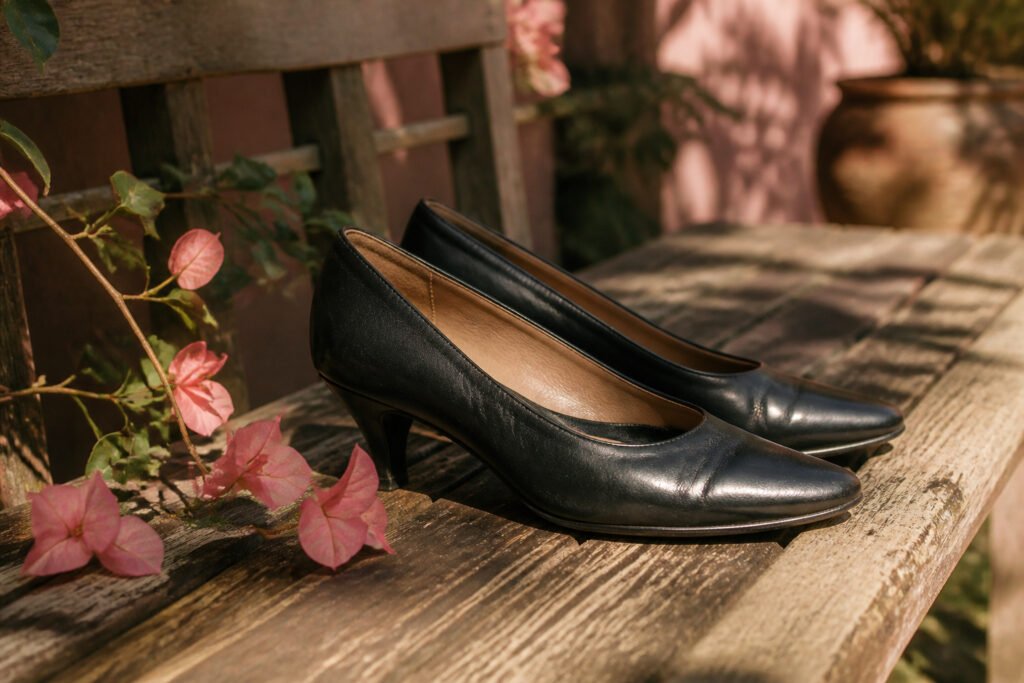
The kitten heel sat at 1.5 to 2 inches, short enough to keep your weight distributed across the foot but slender enough to read as dressy.
In the 1950s, that middle ground mattered. Women moved between housework, social calls, and increasingly common office hours, and a heel that could survive a day on your feet without looking matronly solved a real problem.
The shape itself was typically tapered or slightly curved, narrower than a block heel but nothing like the stiletto that would dominate later.
Leather uppers with modest pointed toes kept the line elongated without the aggression of higher styles. You saw them in patent for evening, in suede or calfskin for day.
What made the kitten heel distinctive was its refusal to choose. It did not announce itself as sensible shoe or glamour statement; it let a woman pass in either world.
The comfort was genuine, not a consolation prize. A 2-inch heel shifts roughly 60 percent of body weight to the forefoot versus 75 percent or more in higher styles, and that difference accumulates over hours of standing or walking.
For women building wardrobes around a few quality pieces, the kitten heel earned its keep. It paired with the sheath dresses and slim skirts of the era without requiring a separate commuter flat.
The trade-off was height, obviously, and the slight visual heaviness of a low heel with a full skirt. But for daily wear, the calculation usually favored the lower option.
3. Loafers

The 1950s loafer was the first shoe many women could put on without sitting down, and that small freedom shaped how the decade dressed.
G.H. Bass had turned a Norwegian farm slipper into the Weejun back in 1936, but by 1951 the style accounted for 60% of everything Bass sold in moccasins, and it had left the field for good. Grace Kelly wore them.
Audrey Hepburn wore them. So did every college girl in America, slipping a penny into the diamond cutout for no reason except that the slot was exactly the right size.
Leather made the difference between a shoe that could pass at the office and one that could handle a Saturday of errands.
The 1950s version sat lower and lighter than what fills shelves now; today’s pairs carry a slightly heavier sole, but the bones are the same.
A woman could wear them with a full skirt to lunch, then swap in cigarette pants for dinner, and the shoe never looked like it belonged to only one of those outfits.
That slip-on ease mattered because her wardrobe was expanding faster than her closet.
The loafer answered a new need: a single shoe that could move between the roles she was already juggling. It did not demand an occasion, which meant one less decision in a morning already full of them.
4. Mary Janes

The Mary Jane carried its schoolyard origin into adult closets without anyone blinking, and that was the point.
A rounded toe and single strap across the instep, fastened with a button or small buckle, let a woman step out of her shoes at the door and back in without sitting down.
In a decade when women moved between house, garden, street, and church, that practicality mattered more than any fashion statement.
Materials stayed humble: leather for the upper, a low heel or none at all, built for standing rather than posing.
The strap did the work laces would have, holding the foot in place while keeping the shoe easy to manage. Today’s revivals tend toward narrower straps and squarer toes, but the mechanism remains identical.
I think the original’s slightly wider strap and softer toe shape look more intentional with full skirts and cropped pants, though the modern version wins for office wear.
5. Oxfords

The 1950s oxford was a lace-up leather shoe built on a last with actual width fittings, a detail that vanished from most modern shelves.
Women then could walk into a store, have both feet measured on a hinged metal plate, and leave with a pair graded narrow to wide.
The shoe itself carried a tailored, almost architectural look: low heel, closed lacing, and a silhouette that read as proper rather than playful.
This made the oxford the most structured option in a decade that still sorted footwear by occasion. A woman could wear black leather oxfords to the office, to church, or out to dinner without the shoe feeling underdressed.
The same pair worked with a suit, a full-skirted dress, or the slimmer sheath shapes that arrived mid-decade. That versatility came from restraint: no open toe, no strap, no ornament beyond the lacing itself.
Saddle shoes sat nearby on the shelf, technically a two-tone oxford with a contrasting instep band, but they belonged to a different world. Teenagers wore them with poodle skirts; their mothers borrowed them for Saturday errands.
The saddle shoe read casual in a way the plain oxford did not, and the distinction mattered then in a way it barely does now, when most "oxfords" in shop windows are saddle shoes with the costume filed off.
What I notice first in a modern reproduction is whether the maker kept the leather sole. Originals had them, and they made a sound, leather on linoleum, that no synthetic replicates.
Most current versions swap in rubber for comfort and skip the width grades entirely. The shape survives; the engineering that made it wearable for a full day standing does not.
6. Wedges

The wedge heel spread through 1950s casual wardrobes for a simple mechanical reason: the sole stays flat from toe to heel while the heel itself rises, so your weight distributes across the entire foot instead of concentrating on a pinpoint.
That construction meant women could gain 2 or 3 inches of height without the wobble of a stiletto or the ankle strain of a narrow Cuban heel.
Cork and wood formed the core, often wrapped in raffia or leather to keep the look light enough for daytime.
Stability mattered more in this decade than nostalgia remembers.
The postwar push toward suburban life put women on grass, gravel driveways, and uneven sidewalks far more than city pavement. A wedge doesn’t sink into lawn the way a spike does, and the wider base catches balance on shifting ground.
I consider this the practical ancestor of today’s platform sneaker: the height is there, but the shoe works with the body rather than against it.
The wrapped cork wedge in natural materials reads as 1950s instantly, while the same shape in glossy patent loses the period feel entirely. If you’re shopping this style now, that material choice matters more than the height.
Weight is the real problem with wedges. A solid wood wedge clocks in heavier than it looks, and after a full day the lift costs you in fatigue.
Cork and rope construction cut that load significantly, which is why those versions dominated summer wear then and still make more sense for actual walking now.
7. High Heels

Heels over 2 inches were the defining statement of femininity and elegance in the 1950s, and no one carried that statement further than Marilyn Monroe.
Her walk in those slender stilettos turned a shoe into an event, something I think about whenever I see a modern red carpet trying to recapture the same electricity. The era treated height as posture and power wrapped into one.
Italian and French houses set the standard for how these shoes were built. Salvatore Ferragamo engineered steel-reinforced stiletto heels that could actually hold a woman’s weight without snapping, a technical problem earlier designers had struggled with.
Christian Dior’s New Look demanded a heel to match its cinched waist and full skirt; the proportions simply fell apart without that lift. The craftsmanship mattered because the silhouette depended on it.
The trade-off was always comfort against line. These were shoes for arrival, not for standing through a long evening, and anyone who has worn a modern reproduction knows the ache in the ball of the foot by hour three.
I still think the visual payoff was real, but the 1950s woman paid for it in blisters and in learning to walk on grass in spiked heels without sinking.
After War, Return to Femininity

The 1950s opened with fabric still rationed and women still wearing the practical shoes they had worked in through the war.
By 1951, that had reversed almost completely. The heel came back, and it came back narrow: a stiletto heel, thin as a pencil, became the silhouette that signaled a woman was no longer dressing for a factory floor.
Christian Dior’s 1947 "New Look" had already reset the line of the dress, nipping the waist and flooding the skirt with twenty yards of fabric.
The shoe had to match that proportion. A heavy sole or a blocky heel would have dragged the whole figure down.
I find the mechanism of this shift worth noticing.
It was not just taste; it was engineering. The steel rod that made the stiletto possible was a wartime material repackaged for civilian use.
Without it, a heel that thin would have snapped under body weight. The same technology that had stabilized artillery pieces now stabilized a woman’s ankle three inches off the ground.
The result was a shoe built for standing still or moving slowly through rooms, not for the bus or the sidewalk. Women owned this trade-off.
The decade’s advertising sold the shoe as a return to grace, and buyers accepted the limitation because the limitation itself was the point. A shoe you could not run in was, in 1953, a luxury.
Materials That Defined the Decade

Leather dominated the 1950s shoe wardrobe, and the grade you bought sent a clear signal. Calfskin or kid leather marked dress shoes and special occasions; the finer grain took polish better and held a structured toe box without looking stiff.
Patent leather, with its mirror finish, reserved itself for evening and the most formal daytime events. I would not have worn it to a lunch date, and neither did most women of the decade.
Suede arrived as the relaxed alternative, usually in pumps or loafers for casual Fridays before that term existed.
It scuffed easily and weather turned it spotted, which meant suede signaled leisure time, not serious business. Nubuck, a brushed calfskin, offered a compromise: softer hand than smooth leather, more forgiving than true suede.
Fabric uppers, often cotton faille or silk, appeared on summer sandals and some evening styles. They cost less, wore faster, and the market treated them as disposable seasonals rather than investments.
Embellishment worked as another material language.
A grosgrain bow or metal buckle on leather elevated a pump without crossing into costume; contrast stitching on a loafer or saddle shoe added visual interest without demanding attention. These details took labor, which manufacturers used to justify price tiers.
A plain leather pump read entry-level; the same shape with hand-rolled piping or a functional tongue buckle read quality. Women shopping then, like women shopping now, learned to read those signals fast.
Ferragamo and Dior

Two names from 1950s footwear still carry weight in vintage references today: Salvatore Ferragamo and Christian Dior.
Ferragamo had spent years engineering what he called the invisible shoe, working with materials like nylon thread and transparent acrylic to create heels that seemed to float.
By the ’50s, his experiments moved into the mainstream, with the caged heel and strapped sandal becoming signatures that balanced couture construction with wearability.
Dior’s influence ran through the whole silhouette, not just the hemline. His New Look demanded a shoe with a more delicate, tapered toe and a mid-height heel that would narrow the ankle above full skirts.
The Dior pump typically sat at about 2 inches, rarely higher, and the toe box was longer and more pointed than the rounded styles of the ’40s.
I find this practical restraint worth noting: Dior understood that his voluminous clothing needed a grounded counterweight, and the heel height he chose reflected that calculation rather than drama for its own sake.
Ferragamo’s archival designs favored color and material innovation: painted leather, woven straw, and the cage construction that exposed more of the foot. Dior’s house leaned cleaner, with monochrome pumps meant to disappear into the line of the outfit.
Both approaches filtered down through the decade. If you are shopping vintage now, a Ferragamo cage sandal reads as event wear, while a Dior-influenced pump from the period works more easily with modern trousers and skirts.
Structure is where these designs show their age: the cage and strap details look worn if hardware tarnishes or threading frays, whereas a well-kept leather pump from either house tends to be easier to condition back into shape.
Workforce and Changing Roles

The slingback heel carried a quiet sound through American offices in the mid-1950s, a soft click on marble tile that announced the working secretary before she rounded the corner.
In a Hartford insurance agency or a Des Moines bank, this was the shoe of a woman who needed to look polished through eight hours of filing and phone calls.
The pointed-toe pump with its narrow heel strap held the foot in place without the full enclosure of a traditional pump, and the half-inch elastic built into that strap meant a woman could slip her foot free under the desk during a long afternoon.
Patent leather, suede, and calfskin versions in wine, taupe, oxblood, and smoke ran between five and nine dollars at modest department stores like Stern Brothers or Halle Brothers.
The practical detail that mattered was this: pantyhose killed the slingback.
A woman in 1956 wore stockings with a seam she straightened in the elevator mirror, and the slingback sat correctly against that bare heel. When pantyhose replaced stockings in the 1970s, the visual logic collapsed.
The shoe did not disappear so much as outlive the woman who needed it, the one who rode the bus home with the strap loosened a quarter inch by 5:00 and the leather worn from a full day of being walked through.
Frequently Asked Questions
What were the popular shoe styles for women in the 1950s?
The most popular 50’s women’s shoes were ballet flats, kitten heels, loafers, Mary Janes, oxfords, wedges, and high heels. Each style served a different purpose, from the all-day flexibility of ballet flats to the statement elegance of stilettos over 2 inches.
The decade’s wardrobe revolved around a few quality pieces, and these seven styles covered every occasion from housework to evening events.
How did 1950s shoe styles reflect societal changes?
50’s women’s shoes reflected a deliberate return to femininity after wartime practicality, with narrow heels and delicate constructions signaling women no longer dressed for factory floors.
The shift was built on repurposed wartime engineering: steel rods developed for artillery stabilization became the thin stiletto shafts that made elevated heels structurally possible. Shoes you could not run in became, by 1953, a luxury that defined the era’s mood.
What should I wear to a 50’s party?
For a 1950s party, choose 50’s women’s shoes that match the occasion’s formality: spectator pumps in two-tone leather for afternoon events, patent leather slingbacks for polished office-era looks, or steel-reinforced stilettos for evening glamour.
A wrapped cork wedge in natural materials reads as instantly period-appropriate for casual gatherings, while a clean Dior-influenced pump in calfskin works with modern trousers if you’re blending eras.
What shoes to wear with a 1950s dress?
Pair a 1950s dress with 50’s women’s shoes that balance its silhouette: kitten heels at 1.5 to 2 inches work with sheath dresses and slim skirts without requiring a separate commuter shoe, while the full skirts of Dior’s New Look need a more delicate, tapered toe and mid-height heel to keep proportions from collapsing.
A ballet flat in soft leather offers grace without the training or discomfort of heels, and the loafer moves between day and evening outfits without looking tied to one occasion.
What are some good women’s 1950s heels?
Good 50’s women’s shoes in heels include the kitten heel at 1.5 to 2 inches, which distributes about 60 percent of body weight to the forefoot versus 75 percent or more in higher styles, and the Ferragamo-engineered stiletto with steel-reinforced construction that could hold a woman’s weight without snapping.
The Dior pump sat at about 2 inches with a longer, more pointed toe box than 1940s rounded styles, designed as a grounded counterweight to voluminous clothing.
Original kitten heels from 1956 in slim, leather-lined, hand-cut versions are now nearly impossible to find in American malls, replaced by plastic, glued-sole reproductions.