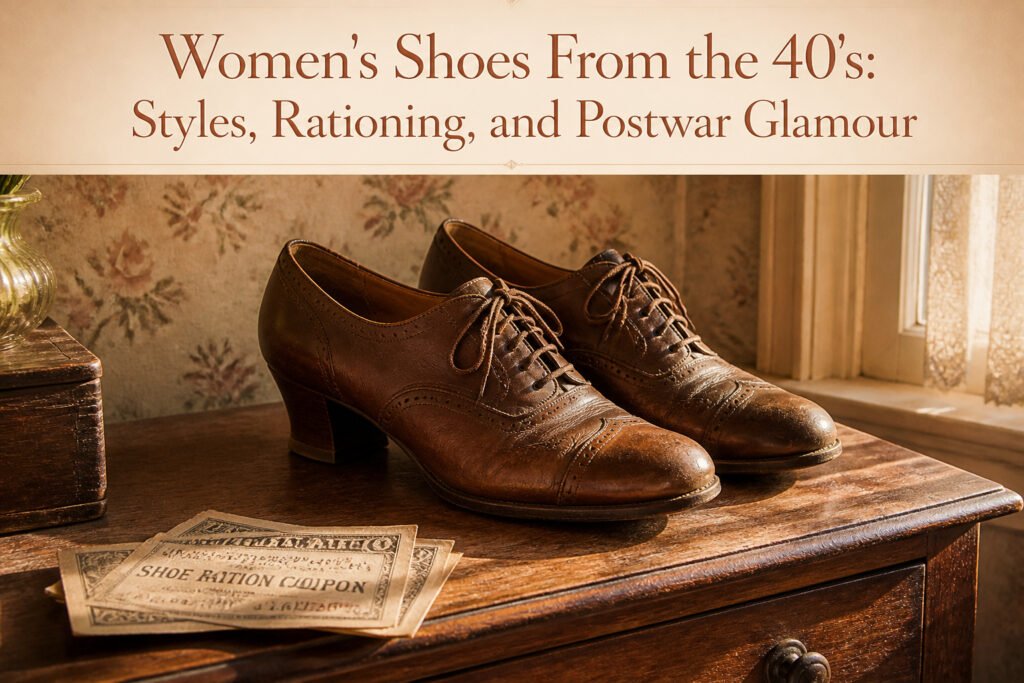
The 1940s woman chose between a Cuban-heeled oxford for the factory floor and a peep-toe slingback for Saturday night, but the deciding factor was never style alone.
Three pairs of leather shoes per year, rationed from February 1943, meant each purchase had to survive daily wear and still pass for evening.
That scarcity shaped everything: cork soles replaced leather, straps saved fabric, and a single shoe with detachable clips could shift from office to date without costing another coupon.
1. Walking Oxfords

The stacked heel, usually 1.5 to 3 inches tall in a Cuban or medium-stacked-leather shape, is what separated a walking oxford from a flat and made it wearable for nurses, teachers, waitresses, and the factory workers who needed support on their feet all day.
These were lace-up shoes, often minimally decorated with brogueing or small accents of patent leather or reptile skin, and the vamp sat high on the foot to cover as much skin as possible, a silhouette that only lowered toward the end of the decade.
Black or brown leather was standard, but leather itself was rationed. In the United States, women could buy no more than three pairs of leather shoes during the war; in Britain, shoes cost roughly five of a yearly forty-coupon allowance.
That scarcity meant a single pair of walking oxfords had to survive years of daily wear, and their sturdy construction answered that need directly.
I think the wartime austerity, the stripped-down detailing, reads as restraint now but was simply necessity then.
A teenager might choose a moccasin-toe version, nicknamed a "moc oxford," while a Rosie on a production line could wear the same basic shoe flat to the ground.
Either way, the walking oxford was the practical default, the shoe that worked with a uniform or a housedress and asked nothing extra of materials already in short supply.
2. Slingback Heels

Slingback heels solved a wartime problem with a simple strap. The buckle sat at the back of the heel, holding the foot in place while skipping the fabric that a full pump would have wrapped across the instep.
That economy mattered when rationing was tight, and the style still managed to look intentional rather than compromised.
Heel heights ran 2 to 2.75 inches for most pairs, with evening versions landing at the taller end and daywear sometimes dropping to a quarter inch or shifting to a wedge sole.
The rounded toe kept the line soft, occasionally with a small peep-toe opening, and decoration stayed minimal by necessity and by choice. What mattered was the heel itself, exposed and framed by the strap.
The look read as glamorous on pin-up posters and Hollywood press shots, though the practical reality was less polished.
Stocking seams showed at the back, which is why many women reserved slingbacks for evening, when long skirts hid the line. Manufacturers eventually answered with reinforced heels and toes, but the style never quite shook its after-dark reputation.
It has cycled back ever since, though the versions that read as genuinely 1940s carry that chunky square heel or wedge sole, thick straps, and plain dark color.
3. Slip-In Pumps

Slip-in pumps carried the decade’s practical spirit without looking drab. The bow sat right on the vamp, sometimes doubled or looped, and cut-outs or perforations added pattern where fabric had to stay plain.
I find the detachable shoe clip especially clever: a woman could pin one on for the office, pull it off for evening, and the same base shoe worked twice as hard.
That mattered when leather was rationed to three pairs a year and every purchase needed justification.
Color ran conservative through most of the war: brown, black, olive green, light tan.
Summer opened up a little with patriotic reds, whites, greens, and blues, a small rebellion against the sober palette. The two-tone spectator pump, usually brown-and-white or blue-and-white, gave the same shoe a sportier read without extra material.
Heels stayed in the 2 to 2¾ inch range, often the curved Louis heel rather than the blockier Cuban shape, so the silhouette kept some elegance even as the toe stayed blunt and the sides rose high enough to banish toe cleavage entirely.
The modest coverage is what dates these most sharply now; a 1940s pump simply uses more material across the foot than its modern equivalent, and that fullness reads as both restrained and deliberately pretty.
4. Peep Toes

A small peep toe punched into the leather of a pump or slingback let a woman’s foot breathe without exposing anything unseemly.
The opening was deliberately tiny, a flash of stocking rather than skin, since a fully visible toe read as vulgar to the conservative tastes of the day.
The cutaway served the war effort, too; less leather per shoe mattered when rationing tightened every supply line.
The detail traveled across practically every 1940s style available: pumps, slingbacks, wedges, loafers, sandals, flats, even bedroom slippers. Day versions kept heels low, sometimes as modest as a quarter inch or a chunky wedge, while evening pairs added height.
Sandals took the idea further with wide straps and thick soles, sometimes woven from dyed straw or fabric in bright blues, greens, reds, or yellows, but that same peep toe anchored them to the decade’s look.
The glamour came with a practical hitch.
That toe opening could snag a stocking seam, and the bare back of a slingback exposed the rear seam entirely. Women saved slingbacks for evening when long skirts hid the back, and manufacturers eventually answered with reinforced heel-and-toe stockings.
Even then, the style stayed a screen-star and pin-up favorite, tight enough that Shelley Winters reportedly muttered a profanity prying hers off each night.
5. Ankle Straps

Ankle straps shifted evening footwear toward cut-outs and exposure that saved leather without looking spare.
The thin straps, often crossing the foot or wrapping the ankle, used less material than a full pump while still reading as formal because they framed the foot rather than simply covering it.
I see this as the wartime solution that accidentally became the silhouette: by 1944, the high ankle strap paired with peep toes and deeper side cut-outs had become the standard for after-dark wear, and the style kept evolving toward more straps, more angles, more placement options as the decade closed.
The construction worked practically too. A strap secured the heel for dancing, which mattered when soles were often wood or cork rather than the rubber that went to military use.
Post-1945, as hemlines dropped and silhouettes turned more feminine, the ankle strap drew attention downward to a narrower, more delicate foot.
The strap itself became the decoration, replacing buckles or brooches that would have added metal or fabric. That minimalism, born from coupon books, ended up defining the look.
6. Wedges

Wedges carried most of the 1940s on their backs.
The thick sole with a medium-height raised heel gave the leg shape that women wanted without the material hunger of a traditional stiletto build, since cork and wood cores replaced leather through the sole itself.
Leather was reserved for military use, so shoemakers stacked wood and cork instead, then covered the whole structure in fabric that matched the upper.
The result read as casual more often than formal, especially in summer iterations with peep toes or slingback straps.
That said, black patent leather or suede could dress a wedge up for evening. Heights stayed reasonable, low enough for actual walking, which kept the style a favorite across the entire decade.
Hollywood helped push platforms later in the period, but the wedge had already solved the essential problem: height with less material, and stability with it.
7. Platforms

Carmen Miranda made the platform shoe impossible to ignore in the early 1940s. The raised sole she wore was modest by later standards, usually only 1–2 inches thick, but that slight lift changed how a woman stood and moved.
The platform distributes body weight across the entire foot rather than concentrating it on a narrow heel or arch, which matters when leather rationing limits how often you can replace a pair.
What separates a platform from a wedge is structure.
A wedge heel is continuous material from back to front, one solid piece under the foot. The platform keeps the sole and heel as two distinct elements: a flat raised base under the forefoot, then a separate heel behind it.
You get height without the instability of a stiletto, and the gap between sole and heel stays visible from the side. That silhouette read as modern and slightly daring in 1943, even at a modest height.
I think the platform’s real appeal was practical glamour. It lifted a hemline visually without requiring new fabric, and the sturdy base paired well with the heavier materials wartime allowed.
After 1945, designers pushed the height higher and the decoration further, but the 1940s version stayed restrained: just enough lift to change the line of the leg, built on a sole that carried weight sensibly.
8. Espadrilles

Espadrilles earned their place in the 1940s through a simple trick of construction: rope or jute soles that count as fiber, not leather.
The wedge heel underneath was built from wood or cork, sometimes left exposed when woven straw facing did not fully wrap it.
Women found them in leather or canvas uppers with laces that wrapped the vamp or climbed to the ankle, closed toes or open peep toes both available.
This was deliberately festive footwear. The platform sank into sand while keeping the foot dry, and teenagers treated the lacing as its own game, tying and retying the thin straps in different configurations.
Leather versions came in red and brown; canvas stayed more neutral. After the war ended, the style loosened further into vacation souvenirs at beach destinations, bright California-construction straw in colors that ration boards would not have permitted.
Modern espadrilles with thick lace-up legs tied in bows are postwar exaggerations. The authentic 1940s silhouette stayed lower, thinner, and more practical about its own Glamour.
9. Sandals

Sandals in the 1940s carried more heft than the name suggests.
Even with the least material of any shoe style, they kept a chunky sole and wide straps that gave them real presence, often finished with heavy buckles in Mary Jane, X-, or T-strap arrangements.
The peep-toe or open-toe design was standard, and many pairs added large cutouts at the vamp for air circulation, a practical concern when leather and rubber were under ration.
The divide between casual and dressy came down to materials.
Plain leather in black, grey, white, or brown sat on nearly flat rubber soles for everyday wear, while cotton canvas opened up color choices that could actually coordinate with an outfit.
Straw or woven fabric versions turned up in blue, green, red, or yellow. Huarache-style sandals with their woven thin straps existed but were rare; they would not become common until the 1950s.
What I find most useful about this style is how it bridged occasions. The same chunky construction that read as practical enough for daytime errands could pass at evening events when the material was right.
A leather sandal with a slight heel and careful hardware did not look underdressed, while the flat canvas version genuinely worked for walking.
That flexibility mattered in a decade when most women owned perhaps three pairs total and each had to earn its keep across multiple settings.
10. Saddle Shoes

Saddle shoes were the casual lace-up that marked a younger, less formal sensibility than the walking oxfords their mothers wore.
The style paired a white base with a darker panel across the middle, usually brown, black, or navy, and sat on a low heel with a thick rubber sole.
Teens made a point of scuffing them up; clean saddle shoes read as trying too hard.
The brown-and-white or black-and-white combinations dominated, worn with bobby socks folded down and everything from skirts to pants. Women borrowed them too, for at-home wear or sportswear, though the look stayed rooted in youth culture.
By 1949 the rubber sole had lightened nearly to white, a small shift that nudged the shoe toward the cleaner 1950s version most people picture now.
Rationing and Three Pairs a Year

Leather shoes became a controlled commodity in the United States in February 1943, with every woman restricted to three pairs per year. That limit dropped to two pairs by March 1944 as leather supplies tightened further.
Six standardized colors simplified production, and the restriction fundamentally reshaped how women thought about footwear. A pair bought in January had to last through December, which meant choosing styles that could move from office to evening and back again.
The British system ran on points rather than pair limits.
Adults received 66 clothing points annually, though that allowance shrank steadily to 24 by 1945. Women’s shoes typically cost seven points each, forcing hard decisions between a new coat and new heels.
The math made repair the obvious choice. Cobblers became essential services, and women learned to resole, reheel, and polish with a diligence that would seem excessive today.
Alternative materials filled the gap where they could. Canvas, rayon, cork, and even wooden soles appeared on utility shoes without the same restrictions.
These substitutes lacked leather’s give and longevity, but they preserved coupon allowances for the moments that mattered. The repair culture born from necessity outlasted rationing itself, a habit of maintenance that faded only gradually as postwar production returned to normal.
What Wartime Shoes Were Made Of

Women’s shoes from the 40’s had to make do without much leather at all.
Military demand claimed the supply, so manufacturers turned to heavy fabrics, felt, fish skins, hemp, mesh, raffia, textiles, and reptile skins. Cork and wood sometimes replaced leather for soles, while straw, rope, and even alligator skin appeared in finished shoes.
The substitutions were not always elegant. A fabric upper with a leather sole technically skirted rationing rules in both the US and Britain, where coupons limited purchases.
US women could buy no more than 3 pairs of leather shoes, and British shoppers spent roughly 5 of their 40 annual coupons per pair. Cloth and faux-leather options, often rayon-based, carried no such restrictions.
Color stayed practical: brown, black, olive green, and light tan dominated, with occasional patriotic reds, whites, and blues appearing in summer months or just before and after wartime proper.
The materials dictated the look. Thick, blunt construction was not merely a style choice; fabric and cork needed more structure to hold their shape.
Utility and Victory Styles

Munition worker boots carried the most direct military influence into women’s everyday footwear, with reinforced toes and flat, lace-up construction built for factory floors rather than fashion.
Leather shortages pushed manufacturers toward canvas, synthetic fabrics like rayon and nylon, even fish skins and hemp, yet the finished boots still read as uniform issue: muted colors, sturdy soles, no decorative waste.
Victory wedges softened the same practical impulse into something women could wear beyond the factory gate. The wedge heel and platform sole stayed stable underfoot, but the silhouette lifted away from pure utility toward morale.
I see them as the compromise that worked: still conserving rubber and leather, still supporting a full shift on your feet, but letting the wearer feel like herself again.
Military styling showed up in subtler ways too. Peasant shoes and clogs borrowed the ethic of resourcefulness rather than the look, wooden soles standing in for rationed rubber, simple construction replacing ornament that no longer mattered.
The era’s best designs, in my view, are the ones that accepted these limits honestly rather than disguising them.
A munition boot in heavy canvas looks purposeful; a victory wedge in the same material looks inventive. Both outlasted the war because they solved real problems rather than pretending the problems did not exist.
From Function to Glamour After 1945

By 1945, leather and silk returned to shoe production almost immediately, and heel heights climbed back up as fast as tanneries could supply them.
The baby doll shoe, which appeared after 1947, captures that rebound exactly: a high heel, low vamp, round toe, and only the slightest platform sole, if any.
Satin and metallic leathers replaced the drab utilitarian fabrics of rationing, and decoration came back with embroidery, beading, and cut-outs on strapless court pumps.
Two-tone coloring in brown and white had been popular earlier in the decade; by the late 1940s, black and white took over as the sharper, more glamorous choice.
Hollywood drove the look harder now, with Rita Hayworth and Marilyn Monroe making peep-toe pumps and strappy sandals the standard for evening. The shift was not gradual.
Women who had been limited to roughly three pairs a year under wartime rules now bought shoes as open statements of femininity rather than concealed practicality, and the industry obliged with designs that emphasized display over durability.
These postwar shoes demanded more care and occasion-matching than the sturdy Oxfords and wedges they replaced; a satin pump did not forgive a puddle or a long walk to the bus.
Gold Cross, Air Step, and Naturalizer

Three American brands built their reputations in the 1940s by making shoes that held up through long shifts and still looked presentable afterward.
Gold (Red) Cross ran advertisements claiming more smart women wore their shoes than any other fine footwear brand in the world, and they backed the boast with specific styles: the Coquette, the Chateau, the Uptown, and the Myra, all offered on a smart medium heel with fit that emphasized an easy stride.
The pitch was quality beyond the price point, aimed at women who needed one pair to carry them from morning to evening.
Air Step took a different angle, designing for the foot itself rather than the occasion.
Their 1940s line included gabardine pumps piped in mountain snake, elasticized slip-ons with patent heels, and a tailored pump laced with sparkling patent from open toe to V-throat.
The elasticized gabardine was practical: it gave through the day, accommodating swelling without going sloppy, and the cut details, like tiny toe cut-outs or diagonal stitching, kept the silhouette trim.
I would pick Air Step for the woman who stood eight hours and still wanted to look polished at dinner.
Naturalizer, the third of the trio, made comfort its explicit promise decades before the category existed as we know it now.
Where Gold Cross sold youth and Air Step sold engineering, Naturalizer built trust through consistency: a recognizable last, a moderate heel height, materials chosen for give rather than flash.
For a working woman in 1943, rationed to three pairs a year, that reliability mattered more than novelty.
If I had to choose one brand to wear daily from this era, Air Step wins for the combination of technical material and considered detail, but Naturalizer wins for the woman who could not afford a misstep.
Frequently Asked Questions
What were the most popular women’s shoes in the 1940s?
The ten most common styles were walking oxfords, slingback heels, slip-in pumps, peep toes, ankle straps, wedges, platforms, espadrilles, sandals, and saddle shoes.
Walking oxfords were the practical default for daily wear, while slingbacks and peep toes carried women from day into evening. Wedges and platforms solved the wartime problem of adding height without using scarce leather across the entire sole.
How did WWII affect women’s shoe styles?
Wartime rationing limited American women to three pairs of leather shoes per year, dropping to two pairs by 1944, which forced chunky, durable construction that could survive daily wear.
Styles grew deliberately minimal to save fabric and leather; slingbacks skipped instep material, peep toes used less leather per shoe, and wedge soles stacked wood or cork instead.
After 1945, heel heights climbed immediately and decoration returned, marking a swift shift from concealed practicality to open glamour.
What materials were used for women’s shoes in the 1940s?
Military demand claimed most leather, so manufacturers turned to heavy fabrics, felt, fish skins, hemp, mesh, raffia, textiles, reptile skins, rope, and straw.
Cork and wood replaced leather in soles, while canvas and rayon-based faux-leather carried no ration restrictions in the US and Britain.
Color stayed practical throughout the war, with brown, black, olive green, and light tan dominating until summer brought patriotic reds, whites, greens, and blues.
How to dress like a woman in the 1940s?
Start with the practical silhouette the decade demanded: walking oxfords or wedge-soled shoes with a blunt toe and stacked heel around two to three inches, paired with a housedress or uniform.
Add a peep-toe pump or slingback for evening, keeping the line simple and the coverage high across the foot.
Stockings with reinforced heels and toes completed the look, since rationing made every item work across multiple settings rather than owning separate shoes for each occasion.
What to wear for a 1940s party?
Choose a peep-toe pump or slingback heel in black patent or suede, with a heel height of two to two and three-quarter inches for authenticity.
Ankle straps with cut-outs read as formal while using less material, true to the wartime origin of the style; add a detachable shoe clip to shift the same base shoe between occasions.
For later in the decade, a baby doll shoe with satin or metallic leather and a high heel captures the post-1947 rebound into glamour.
What were the major women’s fashion trends in the 1940s?
Footwear moved from wartime austerity to postwar exuberance in a single decade. Early 1940s shoes were chunky, blunt-toed, and ration-conscious, with thick wedge soles and minimal decoration serving as both style and necessity.
By 1947, baby doll shoes with higher heels, lower vamps, and satin or metallic materials replaced drab utility fabrics, while two-tone coloring shifted from brown-and-white to the sharper black-and-white that signaled renewed femininity.
What do 1940s dresses look like?
As hemlines dropped after 1945, higher heels and narrower, more delicate shoes drew attention downward, with ankle straps and peep toes framing the foot as jewelry under longer skirts.