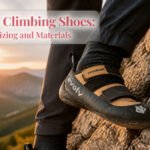
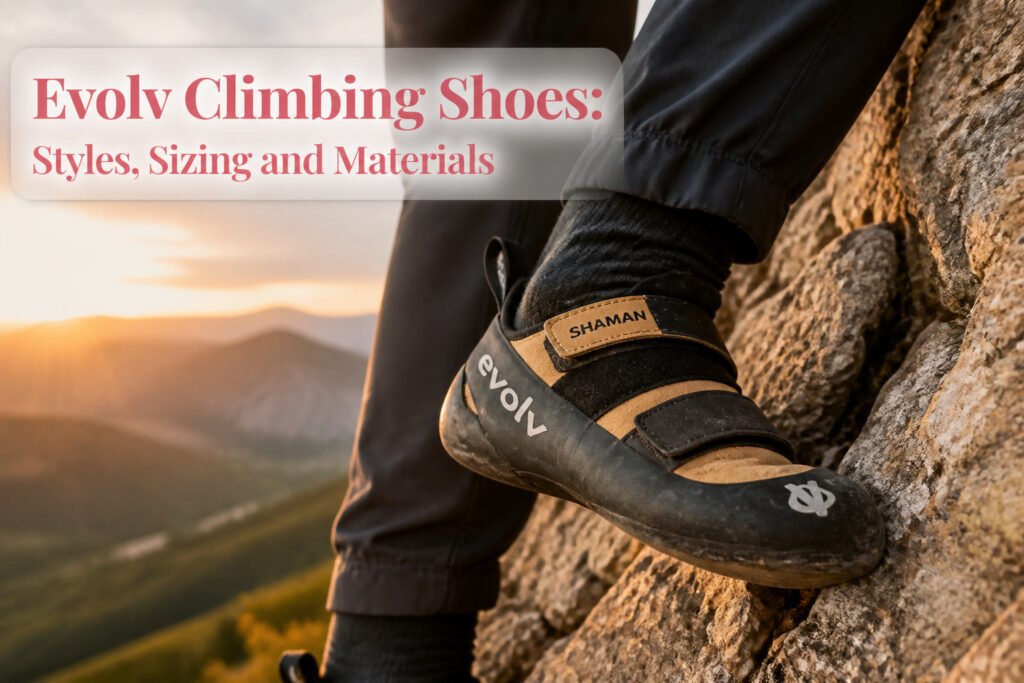
Evolv makes climbing shoes built for the reality that most climbers sit between beginner and expert, and that positioning shows up in sizing more than anything else.
The brand’s lasts run narrow and short, so most buyers need to size up 1 to 1.5 EU sizes from their street shoe size to avoid a return.
The Shaman, a mainstay since 2011, uses three straps and a Love Bump midsole to drive power into pockets while keeping comfort unusually high for an aggressive shoe.
Evolv Shaman

The Evolv Shaman has been a mainstay since its 2011 release as part of the Sharma Signature series, and the third iteration keeps it at the top of most recommendation lists for good reason.
It is built for intermediate and advanced climbers who want one shoe that handles both steep gym boulders and technical outdoor sport routes.
The closure uses three straps rather than the usual two, which I find gives a more secure wrap across the forefoot when you are cranking down on small edges.
The stiff heel cup hooks pockets and overhangs with real precision, and the Love Bump midsole, that curved plate under the toes, drives power into pockets without sacrificing enough sensitivity to read the rock.
Comfort sits at 8 out of 10 in most reviews, which is unusual for a shoe this aggressive.
Smearing suffers a bit: the Love Bump and stiffer midsole that make edging so reliable also make smearing slightly less effective than on a softer shoe.
The synthetic upper and microfiber tongue breathe well but will start to smell faster than leather, a common issue with vegan builds.
At a value rating of 9 out of 10, the Shaman lands where performance and durability justify the price for climbers who are past the beginner phase and climbing regularly.
If your time is split between the gym and real rock, this is the Evolv model I would buy first.
Evolv Defy

The Evolv Defy remains one of the most popular beginner climbing shoes ever made, and that popularity comes down to a simple formula: comfort first, price second, durability third.
The neutral shape, padded tongue, and relaxed velcro closure keep long gym sessions or crag days relatively pain-free, which matters when you are still building foot strength and do not need a shoe fighting you while you learn basic technique.
A full-length 1.4mm midsole provides the support beginners need, since undeveloped toe muscles tire quickly on thinner, more sensitive soles.
The Trax SAS rubber sticks well enough for smearing and foot jamming, and it holds up to the scrapes and drags of sloppy footwork better than softer compounds.
Performance on steep terrain or technical face climbs is limited; the Defy lacks the aggressive downturn and precise edging platform of Evolv’s higher-end models.
That is the trade-off, and an honest one. You sacrifice technical capability for a shoe that forgives mistakes and lasts through the learning phase.
Sizing runs comfortably close to street shoe size for beginners, though more experienced climbers may want to size down slightly for a snugger fit. The Defy is also vegan-friendly, which matters to a growing slice of the climbing community.
At its price point, it is the shoe I would hand to anyone walking into a gym for the first time, with the clear understanding that they will outgrow it technically before they wear it out physically.
Evolv Phantom
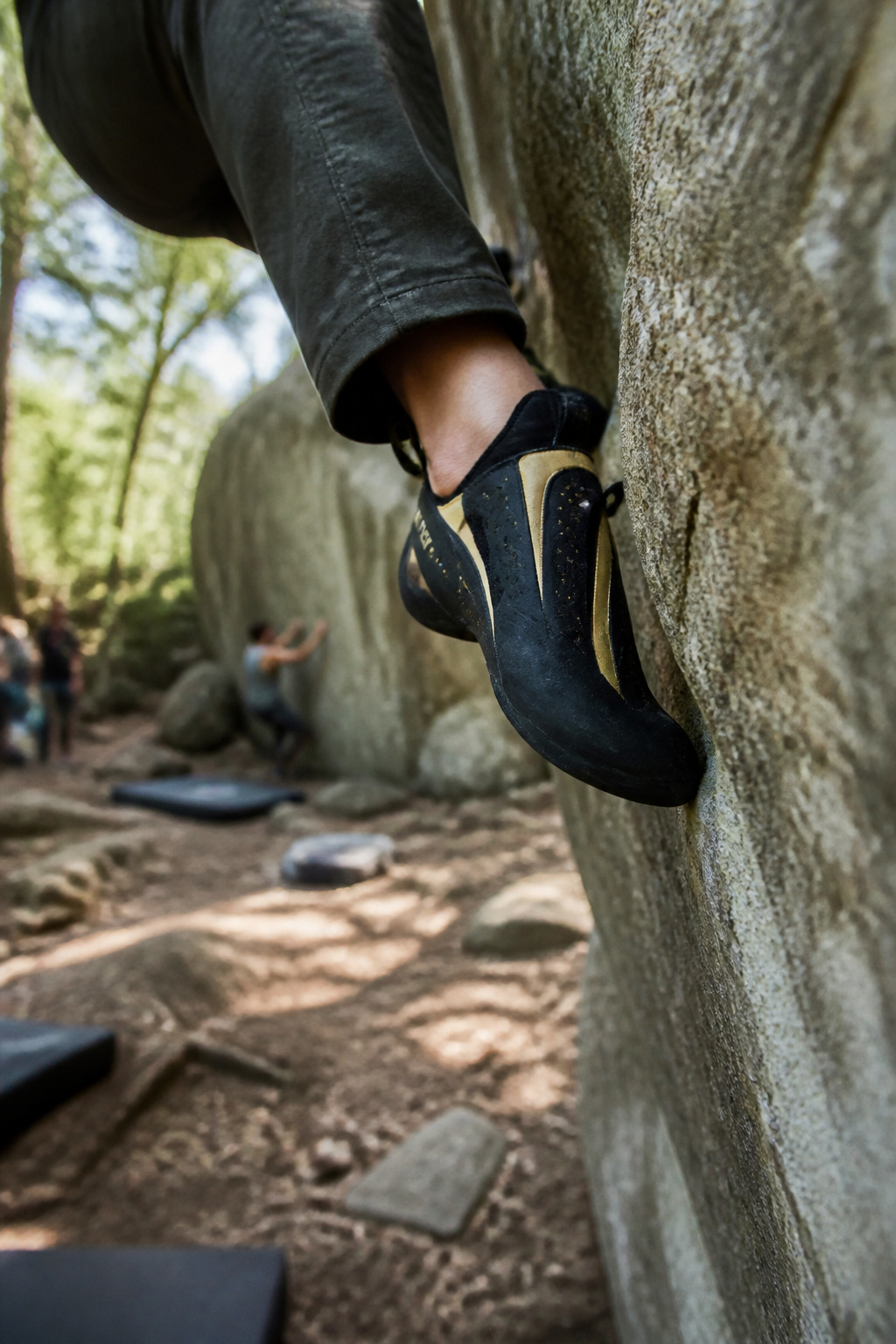
The Evolv Phantom carries a highly downturned shape that drives power straight into pocketed footholds, a geometry that made its name when Daniel Woods sent the second-ever V17 boulder in April 2021 wearing this exact shoe.
That camber comes from two midsoles working together: the AVT plate floats under the forefoot, thinning toward the edges and cut away under the big toe so you feel the hold while still getting support, and the TPS tension system pulls from three points to keep the downturn from collapsing over months of hard use.
For steep terrain, bouldering, and sport climbing, this is the Evolv line’s most specialized weapon. The 6-point closure dials fit precisely enough that the shoe becomes an extension of your foot on overhanging sequences.
Rubber coverage over the toe rand is generous for toe hooks, and the heel cup’s "dark spine" running up the back gives the kind of purchase that lets you commit to high-step heel placements without second-guessing.
The padded split tongue keeps training sessions tolerable, though the Phantom’s aggressive last makes it a poor choice for long trad days where your feet want to flatten out.
This shoe asks for a specific kind of climbing and rewards it with world-class performance.
Evolv Zenist

The Zenist joined Evolv’s line in early 2021 as a shoe built for one purpose only: indoor plastic. Its defining construction choice is the 1mm midsole, thinner than what you’ll find on outdoor-oriented models in the lineup.
That 1mm of rubber strips away underfoot support in exchange for sensitivity you can actually feel on gym volumes and slabs. Smearing becomes intuitive rather than calculated, and precise footholds on plastic register immediately through the sole.
The trade-off arrives the moment you leave the gym. On real rock, that same midsole gives too little support for micro-edges, and the sensitivity that reads volumes beautifully translates to foot fatigue on longer routes.
An aggressive camber, split-sole tension and 4.2mm Trax rubber claw back some edging ability for shorter outdoor climbs, but the Zenist won’t carry you through a full day at the crag.
The synthetic upper keeps its shape without much stretch, which helps fit consistency in the gym though medium volume means it runs short on comfort for sessions that stretch past a few hours.
Evolv Geshido

The Geshido sits in a useful middle ground for climbers who have outgrown their first pair but aren’t ready for the extreme downturn of competition models.
Its moderate downturn and full-length sole give it stiffer underfoot support and solid edging power that pays off on vertical face routes and longer pitches where foot fatigue sets in.
The Dark Spine heel midsole adds some structure, though it lacks the aggressive hooking ability you’d find in the Phantom or Shaman.
I see this shoe as the right call for someone climbing 5.10 to mid-5.11 on faces and light overhangs who wants one pair that handles a full gym session or a crag day without swapping.
The laced version is worth considering if you need a more precise fit around the midfoot. It won’t crush steep cave problems, but that’s the trade-off: you gain comfort and edging precision in exchange for raw overhung power.
How Evolv Sizing Runs
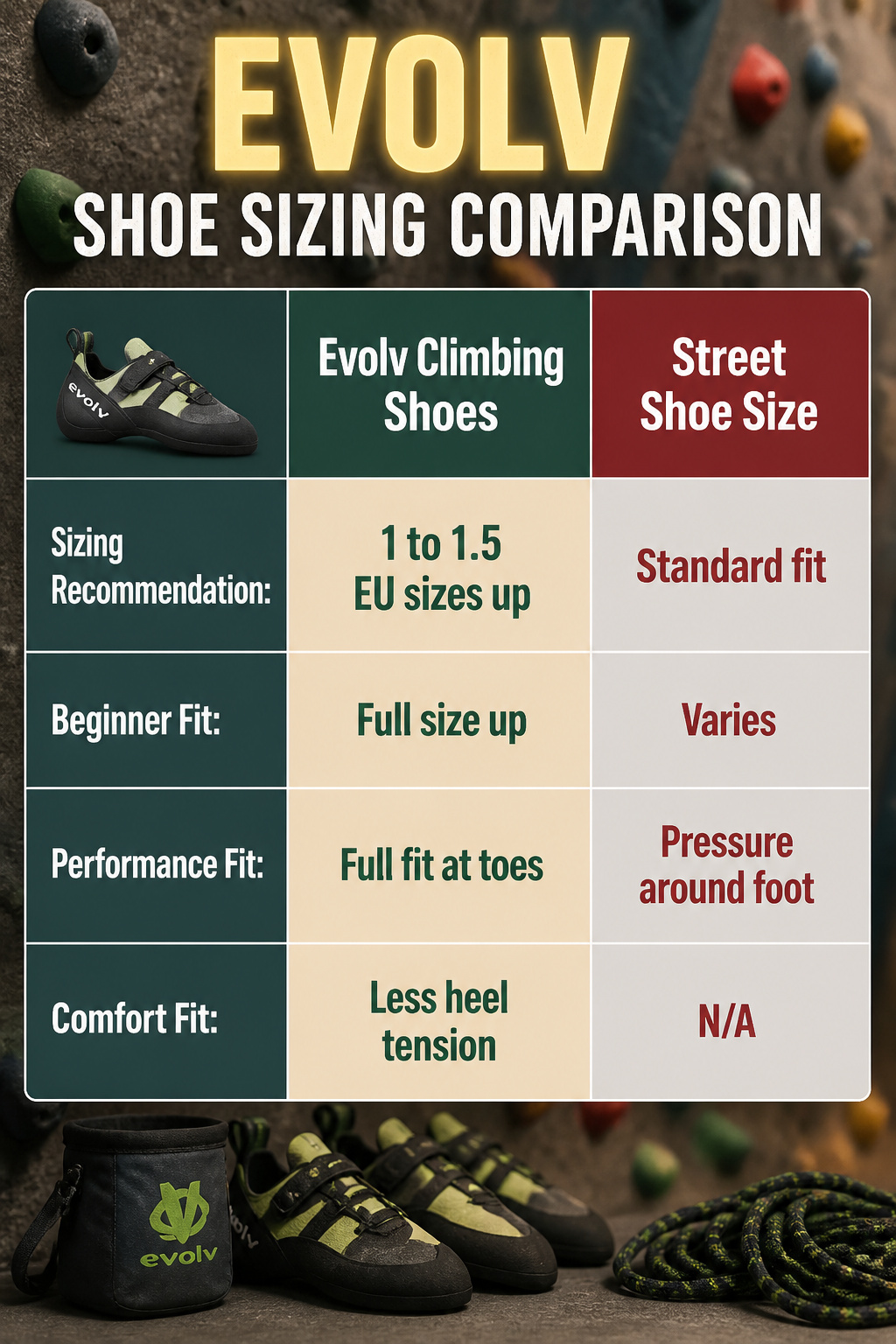
Evolv climbing shoes run small, and most people need to size up 1 to 1.5 EU sizes from their street shoe size to get a workable fit.
The brand’s size guide follows US street shoe sizing, but the actual last runs narrow and short, so going by the chart alone usually ends in a return.
Beginners feel this most. A too-tight shoe shuts down a session early, and beginners lack the technique to compensate for pain.
If you are between sizes, order two pairs and keep the one that lets you stand flat-footed without your toes screaming. Evolv’s 30-day free return policy exists for exactly this.
The fit you want depends on what you are climbing. A performance fit means your toes touch the front, curled slightly, with pressure all around.
You feel the shoe working on small edges. A comfort fit gives flat toes and less heel tension; you sacrifice precision for the ability to wear the shoe for hours.
The Defy Lace, with its perforated leather upper and thinner rubber in pressure zones, is built for that second scenario, and Evolv recommends beginners take it a full size up from street shoe size.
Intermediates can go half a size smaller, experts closer to street size, but that assumes you know what a tight shoe should feel like and why you want it.
Vegan Materials in Evolv Shoes

More than 60% of Evolv’s lineup is certified vegan, a distinction the brand has held since PETA recognized it with a Proggy award back in 2005 for cruelty-free outdoor footwear.
Synthetic uppers replace leather across most models, with the V6 using a 100% vegan upper closed by Evolv’s crisscrossed single-strap Velcro system and a split tongue that overlaps at the center.
TRAX SAS rubber handles the outsole at 4.2mm full-length thickness, while synthetic rands and heel cups provide the abrasion resistance leather once offered.
Performance trade-offs are modest but real.
Synthetic uppers break in differently than leather, often feeling softer out of the box but potentially stretching more over time; the V6’s generous rubber coverage on the toebox and heel cup compensates by adding structure where synthetic material alone might relax.
For climbers prioritizing environmental impact, the absence of animal products comes without sacrificing the technical features that matter: the Love Bump midsole for toe curl support, the narrow-heel-wide-forefoot fit Evolv is known for, and the edging platform that full-length midsoles provide.
The question is whether you value long-term moldability; leather eventually conforms to your foot in a way synthetics approximate but rarely match, though for many the difference is indistinguishable within a single season of regular use.
What Performance Characteristics Share

Evolv’s lineup is built around a single idea that most climbing brands ignore: the largest group of climbers sits between beginner and pro, and their feet deserve shoes that actually fit that reality.
The V6 is where this shows most clearly, offering more support than pro-level downturned models while giving more sensitivity and power than entry-level shoes.
A 4.2mm Trax SAS outsole and a full 1.4mm midsole in the Defy provide the structure newer climbers need for foot strength, but the same brand scales down stiffness and adds split-tongue entry for anyone who wants performance without the punishment.
"Evolv caters to mid-level rock jocks with its V6 rock shoe, straddling the vast ability levels between beginner and advanced."
What this means in practice: you can buy one Evolv shoe, climb in it for years, and not outgrow it before your technique demands something specialized.
The Defy and Defy Lace stay comfortable for all-day gym sessions with padded tongues and neutral shapes, while the V6’s low-volume option tightens the fit enough to compensate for the sensitivity trade-off softer shoes deliver.
Versatility here is not marketing speak; it is a deliberate stiffness range that works for slab smearing, vertical edging, and moderate overhangs without forcing you into a quiver of single-purpose shoes.
Frequently Asked Questions
What are the best Evolv climbing shoes?
The best Evolv climbing shoes depend on your level and style.
The Shaman is the top all-around pick for intermediate and advanced climbers splitting time between gym and crag. Beginners should start with the Defy for its comfort and durability.
The Phantom excels at steep bouldering and sport climbing, the Zenist is purpose-built for indoor plastic, and the Geshido fills the gap for climbers moving past their first pair but not ready for extreme downturns.
How do I size Evolv climbing shoes?
Size up 1 to 1.5 EU sizes from your street shoe size.
Evolv’s size guide follows US street sizing, but the actual last runs narrow and short, so the chart alone usually leads to returns. Beginners should err larger; a too-tight shoe ends sessions early.
If you are between sizes, order two pairs and use Evolv’s 30-day free return policy. The Defy Lace runs a full size up for beginners, half a size down for intermediates, and street size for experts.
Are Evolv climbing shoes vegan?
More than 60% of Evolv’s lineup is certified vegan, a distinction the brand has held since PETA awarded it a Proggy award in 2005. Synthetic uppers replace leather across most models, with options like the V6 using a 100% vegan upper.
Synthetic rands and heel cups provide abrasion resistance, and TRAX SAS rubber handles the outsole. Synthetics break in differently than leather, often feeling softer initially but potentially stretching more over time.
Why are climbing shoes expensive?
Climbing shoes carry specialized construction costs: shaped lasts, precision rubber compounds like Evolv’s 4.2mm Trax SAS, tensioning systems, and hand-built assembly in lower volumes than mass footwear.
Performance models add features like dual midsoles, split-tongue closures, and extensive rand coverage that drive material and labor costs.
The price reflects both durability and the R&D behind designs that must balance support, sensitivity, and fit across wildly different foot shapes and climbing styles.
Is Evolv a good climbing brand?
Evolv is a respected brand founded in 2003 and now owned by the Oberalp Group, which also operates Salewa, Wild Country, and Dynafit. Its team includes prominent climbers like Ashima Shiraishi, Daniel Woods, and Kai Lightner.
The brand distinguishes itself by designing for the large middle ground between beginner and pro, with deliberate stiffness ranges and fit options that let one shoe serve multiple years of progression.
Its vegan certification and free 30-day returns add practical value for a wide slice of climbers.
How much are climbing shoes?
Entry-level models like the Evolv Defy typically sit at the budget end, while specialized performance shoes like the Phantom or Shaman run higher.
The Defy earns a 9 out of 10 value rating in reviews, with performance and durability justifying the price for regular climbers.
Higher-priced shoes generally invest more in rubber coverage, tensioning systems, and refined lasts. Most climbers get better value buying one versatile shoe that matches their actual level than overspending on pro-level downturn they cannot yet use.
What shoes did Alex Honnold use in Free Solo?
Alex Honnold wore La Sportiva Solution Comp shoes during his 2017 free solo of El Capitan’s Freerider, not Evolv.
The Solution Comp is a highly downturned, sensitive shoe from an Italian competitor. For climbers seeking a similar profile in the Evolv lineup, the Phantom offers comparable aggressive downturn and toe precision.