Von Maur is a mid-tier department store chain that stocks women’s shoes across roughly fifteen categories, from waterproof suede ankle boots to platform wedges and over-the-knee leather shafts.
Expertise and construction quality vary sharply by section: gait analysis is absent from the athletic floor, fashion combat boots borrow the look of moto gear without CE-rated protection, and sandals mostly skip contoured footbeds entirely.
A Vionic waterproof suede ankle boot solves the slush problem that kills standard suede, while a Schutz Ariella sandal at 3.9 inches demands a seated dinner, not a standing reception.
Prices generally track even with Nordstrom but run above clearance events at specialty running shops, with entry-level leather loafers like the Franco Sarto Bocca reselling near $50 and over-the-knee styles climbing past $400.
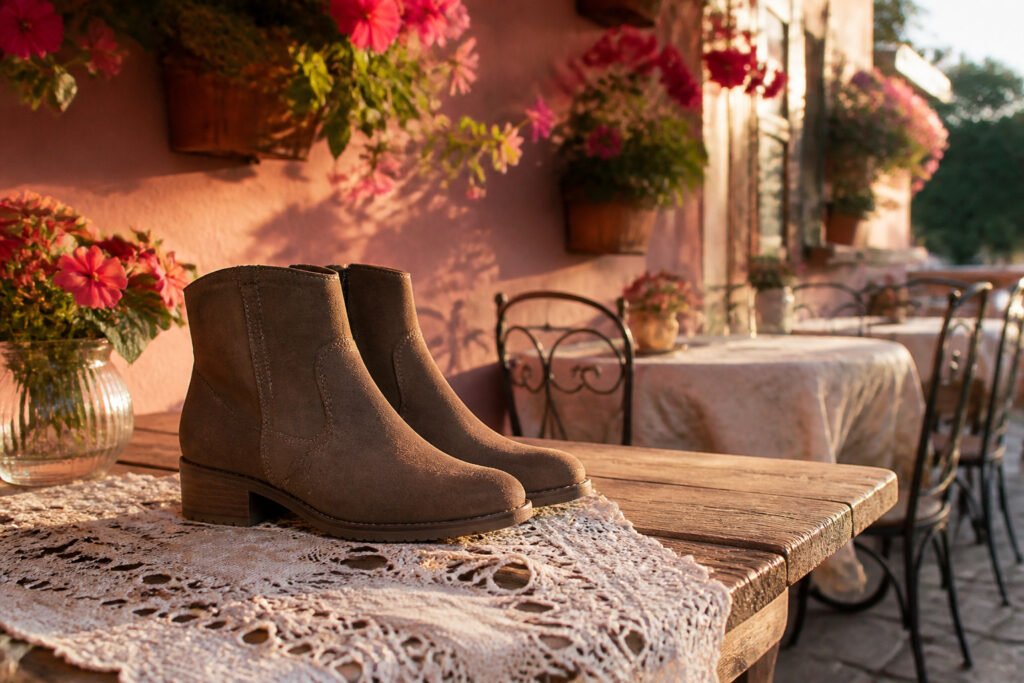
Ankle Boots & Booties

Ankle boots sit at the center of Von Maur’s boot sales because they handle two wardrobes at once.
A waterproof suede option like the Vionic Women’s Waterproof Suede Ankle Boot solves the practical problem most women face: suede looks refined, but standard suede dies in slush.
The waterproofing keeps the texture presentable through commuter walks and parking-lot puddles without the rubber-boot downgrade.
Heel heights in this category cluster where comfort and polish overlap. Most pairs run from flat to about 2.5 inches, with block heels and low wedges outnumbering stilettos by a wide margin.
That range is deliberate. It lets you wear the same boot to a casual office Friday and straight into Saturday errands without a change.
The bridge is what sells them. Ankle boots pair with straight-leg trousers that already hang in your closet, then switch to jeans without looking like an afterthought.
The shaft hits just at or below the ankle bone, so it does not fight hemlines the way taller boots do. For women building a smaller, harder-working shoe collection, that versatility justifies the price step up from fast-fashion alternatives.
Athletic Shoes

Von Maur stocks running and training shoes from the usual sportswear names you’d expect at a mid-tier department store, and the selection lands about where that positioning suggests.
You’ll find Nike, Adidas, New Balance and Brooks on the floor, with the occasional Saucony or ASICS depending on the season.
The range skews toward daily trainers and cross-trainers rather than race-day flats or trail specialists; think Pegasus and Ghost rather than Vaporfly or Cascadia.
Prices run roughly even with Dick’s or Nordstrom, but a step above what you’d pay at a dedicated running shop during a clearance event. The real gap is in expertise.
Staff at Von Maur can point you toward a cushioned neutral shoe versus a stability model, but gait analysis and fitting nuance aren’t part of the service the way they are at a local running store.
If you already know your size in a given brand and just need to replace a worn pair, the convenience works.
For a first serious running shoe or a persistent injury issue, I’d still make the trip to a specialty store even if it means paying $10–20 more.
Combat & Moto Boots

The lug sole depth and hardware weight separate real combat boots from ankle boots that merely borrow the silhouette.
Von Maur’s selection leans toward fashion interpretation rather than motorcycle-grade protection: you will find zippers instead of steel shanks, buckles that adjust fit rather than secure shift pads, and leather that is corrected-grain or suede rather than full-grain hide built to take highway abrasion.
I look for a sole that carries some actual tread pattern, not the shallow scoring that slides on wet pavement.
The boots that work for daily wear at Von Maur typically stack a 1.25 to 1.5 inch heel under that lug, which gives enough lift to clear puddles without the blocky clunk of true work gear.
Brass-finish eyelets and side zippers show up consistently; functional speed-lacing hooks, the kind you could operate with gloved hands, are rare.
Combat boots give you toughness but sacrifice flexibility; the sole is stiff out of the box and the break-in period lasts a week or two.
Fashion combat boots pair with slim trousers and midi skirts without dominating the outfit, but they will not save your ankle from a bike laid down at speed.
If you need CE-rated armor or oil-resistant sole compounds, you are shopping the wrong department entirely. For walking city streets through fall and early winter, the Von Maur range is perfectly reasonable.
I would just check that the insole comes out, because the factory padding in this price tier usually compresses within a season and you will want to swap in something with actual arch support.
Espadrilles

The Tory Burch Arianne Espadrille Loafers in Daylily Yellow suede are the pair to look for at Von Maur if you need something that reads polished without going full corporate.
The jute sole construction gives you that braided, rope-wrapped platform base traditional to espadrilles, which lifts the foot just enough to keep trousers from dragging while still feeling like a summer shoe.
Jute breathes better than rubber or leather soles in heat, and the loafer upper keeps the line covered where a sandal would feel underdressed.
I see these working best in offices that relax the dress code from Memorial Day through Labor Day: the suede upper and structured silhouette pass for intentional, while the natural fiber sole signals you are not trying too hard.
Jute softens and stains in rain, so espadrilles are not your grab-and-go pair for stormy commutes.
Keep a leather loafer or low-profile sneaker in your desk drawer for those days, and rotate the Arianne in when the forecast holds dry and the meeting calendar stays light.
Flats & Loafers

Flats and loafers make up the single biggest slice of what Von Maur carries, and the difference between a loafer that holds up and a ballet flat that dies in six months usually comes down to what’s under your heel.
The Franco Sarto Bocca loafer shows up resold at $50, and that price point matters because it tells you where Von Maur positions its entry-level leather: not bargain-bin, but not investment-grade either.
What separates it from the Josef Seibel Pippa 07 ballet flat at $40 is the structure. A loafer has a built-in shelf for your arch; a ballet flat lies flat against the insole and expects your foot to do all the work.
I look for three details that signal whether either style is built to last. Stitching that runs through the sole edge rather than glued trim that stops at the welt means the upper won’t peel away when humidity hits.
A leather insole that darkens with wear but doesn’t crack, versus a synthetic lining that pills.
And weight: the Bocca has enough heft that it doesn’t fold in half when you pick it up, which translates to a heel counter that keeps its shape through thousands of steps.
The Pippa 07, by contrast, is suede and gray and reads comfort-first, which is fine for desk days but not for walking blocks.
The trade-off is real.
Loafers read more structured with cropped trousers; ballet flats disappear under a maxi and feel cooler in July heat. If your closet leans toward one pair that works five days a week, the loafer’s arch support wins.
If you need something that packs flat for travel, the ballet flat’s flexibility matters more. Neither is wrong, but only one of them saves your calves by Thursday.
Heeled Boots

Heeled boots sit a few inches above the ankle, and that extra shaft height changes what you can pair them with.
A 2.5-inch stacked heel under a leather shaft that hits mid-calf works with straight-leg jeans that would swamp an ankle bootie.
The heel itself matters more than the height number. Stacked heels, built from layered leather or rubber, compress slightly as you walk and return energy in a way a stiletto heel simply cannot.
At Von Maur, the brands that engineer for walking rather than posing put a rubber tap on the heel strike and a steel shank through the arch.
The stiletto versions look sharper with a midi skirt for dinner, but the stacked-heel options are what I would wear for a day that involves actual pavement. A stacked heel adds ounces, and by 4 p.m. you feel that difference.
If your commute includes more than three blocks, the stacked heel wins. If you are parking directly at the restaurant door, the stiletto is not foolish.
Heels

Pumps and heeled sandals at Von Maur cluster toward the upper half of the store’s range, with Calvin Klein ribbed Epi leather pumps originally tagged at $109 and Louise et Cie bow flat sandals listing at $110 before markdown.
The Schutz Ariella heel sandal carries a 3.9-inch heel height, which sits at the practical ceiling for all-day wear without shifting weight too aggressively onto the ball of the foot.
For women who need real cushioning under that height, the platform wedge and block-heel constructions are the styles to hunt for.
Donald J Pliner’s Clem-D pump uses a mirrored block heel that spreads impact across a broader base, while Kate Spade’s platform wedge slide builds lift from the front as well as the back, reducing the effective pitch angle and the pressure on the forefoot that a steeper incline creates.
These are not fitness-shoe comfort levels, but they are the architectural choices that let a 3-inch heel survive a workday without the burning sensation that kills pumps by 2 p.m.
The secondary market tells the rest of the story: Von Maur heels resell as low as $30, which suggests many buyers found the fit or the pitch unsustainable.
I would try before committing at full price, and I would not buy a stiletto here unless it has that front platform to offset the slope.
Lace Up Boots

Lacing gives you a fit zipper boots simply cannot match.
You control tension across the instep, the ankle, and the shaft separately, which matters when one foot swells more than the other or when you need real ankle support on uneven pavement.
A zipper saves seconds at the door but locks you into whatever last the manufacturer guessed would fit most women.
Von Maur’s lace-up range runs heavily toward fashion boots with decorative eyelets and thin round laces that look rugged without the structure to back it up.
The soles flex easily, the shafts sit below the ankle bone or just barely above it, and the hardware is often antique brass or matte black rather than the locking hooks you’d see on a trail boot.
That is not a flaw if you want a city boot that reads outdoorsy, but do not buy these expecting hiking support.
For actual trail use, I would look elsewhere; Von Maur stocks better technical options in their athletic and hiking categories, and the lace boots here are styling tools, not tools for the job.
If you need a boot that stays comfortable through a full day of walking, the fashion lace-ups work fine.
The adjustability still helps with fit, even when the sole is lightweight. Just know the trade: you are paying for the look of function, not function itself.
Moccasins

Soft sole construction separates a proper moccasin from flat-soled imitations that flatten against pavement in a week.
The layered leather outsole flexes with your foot and breaks in rather than breaking down, which is why I look for it even in indoor styles.
Suede uppers at this price point feel more forgiving across the instep than full-grain leather, though they stain faster and need a spray before the first wear.
Leather uppers hold structure longer but start stiffer; if you are between widths, suede usually wins.
Von Maur’s moccasin selection runs thinner than their other categories. You will find slipper-style versions with padded insoles and indoor-outdoor rubber dots, not true driving moccasins with the pebbled heel patch meant for pedal grip.
The distinction matters if you planned to wear them beyond the house. For actual driving shoes, I would look elsewhere in their loafer section or at another retailer entirely.
Mules & Clogs

Backless construction is what separates a mule from any other closed-toe shoe, and that missing heel counter changes everything about how it needs to fit.
Without the strap of a slingback or the enclosure of a loafer, your foot is held only by the toe box and the vamp, which means the ball of your foot must sit exactly where the shoe intends or the whole thing walks right off.
I have learned to test mules by standing on my toes; if the heel lifts more than a finger’s width, the throat is too loose and the shoe will clatter with every step.
Heel heights run the full range from flat soles to 3-inch blocks, and the weight distribution shifts dramatically as you climb.
A flat mule puts all the hold on your instep, which is why I prefer brands that add elastic goring at the sides or a discreet adjustable strap across the vamp.
Those details do what the missing heel cup cannot: they let you tighten the shoe to your actual foot rather than hoping the standard width matches yours.
Block heels help by adding some rear weight, but they do not fix a loose fit, they only make the flop less noisy.
For the Von Maur shopper, this means trying on matters more than with almost any other closed style.
A half size down can anchor the foot better, though you risk pinching at the toes. I would rather pass on a mule that slides than gamble on heel grips that bunch and show at the back.
Over the Knee Boots

Shaft height is what separates a true over-the-knee boot from a tall boot that only looks like one. For genuine over-the-knee coverage, you need roughly 20 inches or more from sole to top edge, measured up the back of the leg.
Anything less than that lands in above-knee territory, where the top of the boot sits below the kneecap gap even on average-height wearers. Von Maur’s selection leans toward this taller silhouette in its boot category, though stock varies by season.
Material matters more here than in ankle or mid-calf boots because the shaft has to curve with your leg without dropping.
Leather with moderate stretch or suede with a slight nap tends to hold position without sliding; stiff, unlined leather that won’t give across the knee will gap or fall, no matter how good the grip strip inside.
That extra material adds cost. Over-the-knee boots at Von Maur generally run higher than comparable ankle styles from the same brand, often starting around $150 and climbing past $400 for leather that can actually walk in.
I would skip anything under $120 in this category; at that point you are usually paying for a tall boot shaped like an over-the-knee, not a boot built to stay up.
Platforms

Platform soles do something simple but useful: the thick front sole subtracts from the heel lift, so a 4-inch heel on a 2-inch platform wears like a 2-inch heel.
That math matters for all-day comfort, and it is why platforms stay popular at Von Maur across three very different shoe types.
Sneakers with platform soles add height without the instability of a heel, though the extra sole weight can feel clunky if the foam is too dense.
Sandals use the platform to keep the footbed flat while lifting you above hot pavement or uneven ground, which works best when the sole has some flex at the ball of the foot.
True platform heels, the dress-shoe kind, give the leg-lengthening effect of a stiletto but spread your weight across the full foot instead of pitching it forward onto the toes.
The brands that do this well at Von Maur tend to be the ones already known for comfort engineering.
Steve Madden and Madden Girl usually offer the widest range of heights and finishes, while Naturalizer and Clarks build platforms with more arch support and lighter midsoles.
If you are deciding between them, try the bend test in the store: a platform that flexes slightly at the forefoot will walk more naturally than one that planks flat.
Sandals

Von Maur’s sandal selection runs heavy on dressy options, which makes sense for a department store anchored to occasion shopping.
The Schutz Ariella heel sandal sits at a 3.9-inch heel height with thin straps, the kind of shoe that carries a wedding guest outfit but leaves you hunting for a rideshare by 10 p.m.
I would wear that to a seated dinner, not a standing cocktail hour.
For something flatter, the Louise et Cie bow flat sandal and the All Black fisherman lug-sole style both trade height for walkability, though only the All Black adds actual tread.
Slide styles show up in two forms: the Kate Spade platform wedge with its bow detail, and simpler leather versions from brands like Louise et Cie.
The wedge gives you lift without the ankle strap commitment, which matters if you’re dressing around a pedicure still drying or just dislike buckles.
What I do not see much of in the Von Maur sandal mix is sport construction. The All Black lug sole comes closest, but it is still a fashion sole, not a contoured footbed.
For women who need arch support, Von Maur’s sandal wall is basically flat-base territory. The dress sandals especially run on thin, unshaped insoles.
If you are standing all day, I would skip this section entirely and head to their athletic brands instead, or plan to swap in an aftermarket insole and hope the strap placement cooperates.
Slippers

Indoor-only soles at Von Maur lean toward soft felt or light rubber meant for carpet and hardwood, while the indoor-outdoor options carry a harder tread that can handle a quick mailbox run without shredding.
Shearling-lined and memory foam versions do show up, but they are scattered thin across the inventory, usually buried two or three clicks deep under seasonal tabs rather than given their own category page.
I have noticed the slipper selection reads like an afterthought because Von Maur builds its floor around occasion dressing and brand names people recognize from the mall.
A plush shearling mule does not photograph as well as a heeled bootie, and it does not carry the markup either.
If you want memory foam underfoot, you will likely find it rebranded inside a Dearfoams or Isotoner package rather than as a standalone luxury item.
My take: shop this section only if you already have a cart open for something else.
The soles are adequate, the warmth is real, but the range is too narrow to make a special trip. For a true indoor-outdoor hybrid with arch support, you are probably leaving Von Maur’s site unsatisfied.
Sneakers

The sneaker wall at Von Maur sits apart from the performance running section, and that separation matters.
Fashion sneakers, retro reissues, and designer collaborations dominate this floor space: think platform soles, quilted leather, and colorways that reference 1970s tennis rather than marathon training.
I handle the distinction by checking the outsole first. Running shoes flex aggressively at the ball of the foot; fashion sneakers often run a stiffer board or a wedge that would punish a jog around the block.
Sizing here drifts toward streetwear standards, which means half a size down from your athletic fit is usually the right call.
Brands like Steve Madden, Sam Edelman, and Marc Jacobs tend to build on a slightly narrower last than Nike or Adidas performance lines, so a 9 in running gear becomes an 8.5 in most Von Maur fashion sneakers unless you have a wide forefoot.
The exception is the occasional unisex collaboration drop, which sometimes uses men’s sizing converted over and runs long.
Retro styles from Puma and Reebok have resurfaced heavily in recent seasons, and I find their foam less forgiving than modern athletic midsoles.
A full day of standing in a Puma Suede or Reebok Club C demands an insole swap, something Von Maur’s free alterations desk can handle if you ask during purchase.
Designer collaborations, when they land, command the premium you’d expect but rarely justify it in wearability. I skip those unless the silhouette solves a specific gap in my closet.
Wedges

Wedges spread body weight across the full foot, which is why I reach for them when a heel is non-negotiable but a stiletto would have me shifting my weight onto the ball of my foot by noon.
A cork core compresses slightly as you walk and rebounds between steps, while foam stays lighter but flattens faster, so the shoe loses its lift mid-season.
At Von Maur, the brands that get heel height right for actual walking tend to land in the 2.5 to 3.5 inch range; anything taller and the wedge starts working against the stability it was built for.
Spring and summer are when the selection opens up, with espadrille wraps and leather straps replacing the closed-toe shapes that trickle in for early season events.
Winter & Rain Boots

Actual winter performance and fashion rubber sit in different aisles at Von Maur, and the gap matters once the temperature drops.
Insulation rated to –20°F or lower separates boots you can commute in from boots that just photograph well; most of what Von Maur stocks in this functional category carries that rating, though the selection runs narrow compared to their dress boot or sneaker walls.
Waterproofing levels tell the same story.
Full-grain leather with a sealed seam and a gusseted tongue blocks slush better than the treated suede panels on trendier styles, and the lug depth on the outsole, 4–6 mm on proper winter pairs, grips where fashion treads slip.
I have noticed Von Maur carries fewer deep-lug options than a dedicated outdoor retailer, and rain boots, when they appear, lean toward glossy rubber shafts rather than insulated neoprene builds.
For someone walking icy parking lots daily, that limited range means planning around one or two reliable brands rather than browsing broadly.
If your winters stay mild, the fashion options work fine. Once salt and packed snow enter the picture, the functional stock sells out fast, and restocks lag behind the seasonal calendar by weeks.
Brands to Know

Vionic, Tory Burch, and Franco Sarto each carve out a distinct corner at Von Maur, and the split matters more than the logo on the box.
Vionic dominates the comfort-and-support lane. Expect to pay about $178 for its waterproof suede ankle boot and $150 for its Stanton wedge pump, which places the brand mid-to-upper range against the full Von Maur lineup.
The brand builds around biomechanical footbeds, so it wins for women who stand long hours or need arch support without sliding into orthopedic-looking territory.
Tory Burch lands in a different zip code entirely. The Arianne espadrille loafers surface at $99 in the resale listings, but that is secondhand pricing on a brand whose new suede flats and signature hardware typically run higher.
At Von Maur, Tory Burch owns the polished-casual space: loafers, ballet flats, and espadrilles that read office-appropriate but not corporate-stiff. The yellow suede and bow details in the listings back that up.
Franco Sarto holds the accessible-classic ground.
The Bocca loafer appears at $50 resale, originally from Von Maur, and the brand’s slip-ons and low heels fill the gap between Vionic’s function and Tory Burch’s fashion. Leather construction, clean lines, and heel heights that stay walkable define its territory.
My read: start with Vionic if your feet hurt by 3 p.m., Tory Burch if the shoe needs to carry a meeting, Franco Sarto if you want both to last past one season without a painful receipt.
What the Prices Mean

At Von Maur, $40 to $60 lands you synthetic flats, basic sandals, and casual booties from labels like Josef Seibel or Dirty Laundry, often with textile uppers and rubber soles made overseas.
Step up to $80 to $140 and the materials shift: Lucky Brand leather booties, Louise et Cie suede sandals, and Bandolino ankle boots cluster here, with stitched construction and brand licensing costs baked in.
The $140 to $250 band is where Paul Green Chelsea boots and higher-end Enzo Angiolini suede styles sit, typically carrying European manufacture or more complex lasts.
The resale data shows the gap clearly: a $225 Enzo Angiolini boot resold at $20, while a $175 Paul Green held firm, suggesting where the actual leather and German assembly justify the ask.
I would spend at the $80 mark for leather that breaks in rather than breaks down, and treat anything under $50 as a season-specific buy, not a wardrobe anchor.
Sizing and Fit Notes

Von Maur’s site does not list a unified size chart or width availability across its women’s shoe inventory, so check the brand’s own sizing before you order.
A size 8 in Vionic’s American lasts fits differently than an 8 in Tory Burch’s European-based lasts, where I have found the toe box runs slightly narrow and the heel a touch wider.
If you are between sizes or need a wide or narrow width, the safe move is to pull up the label’s official fit guide rather than trusting the department store’s generic dropdown.
Returns at Von Maur are straightforward, but trying to guess your way through Italian, French and US sizing systems in one cart is how you end up with three boxes and nothing that works.
Frequently Asked Questions
What types of women’s shoes does Von Maur carry?
Von Maur carries 17 distinct categories of women’s shoes: ankle boots and booties, athletic shoes, combat and moto boots, espadrilles, flats and loafers, heeled boots, heels, lace-up boots, moccasins, mules and clogs, over-the-knee boots, platforms, sandals, slippers, sneakers, wedges, and winter and rain boots.
The selection spans everything from waterproof commuter boots to dress sandals, with fashion sneakers and retro styles holding significant floor space alongside more traditional department store staples.
Are there specific brands available at Von Maur?
Yes.
The shoe department stocks Michael Kors, Betsy Johnson, Steve Madden, Sam Edelman, Marc Jacobs, Tory Burch, Kate Spade, Calvin Klein, Louise et Cie, Schutz, Donald J Pliner, Franco Sarto, Josef Seibel, Vionic, Naturalizer, Clarks, Puma, Reebok, Nike, Adidas, New Balance, and Brooks.
Athletic names sit alongside fashion labels, with designer collaborations appearing seasonally.
What are the price ranges for women’s shoes at Von Maur?
Prices range from about $20 on the resale market for clearance boots up to $400 and above for leather over-the-knee styles.
Entry-level leather loafers sit around $50, pumps originally tagged at $109 resell near $59, and heel sandals list at $110 before markdown. Most categories cluster in the $50 to $250 range, with occasion heels and premium boots pushing toward the top of that band.