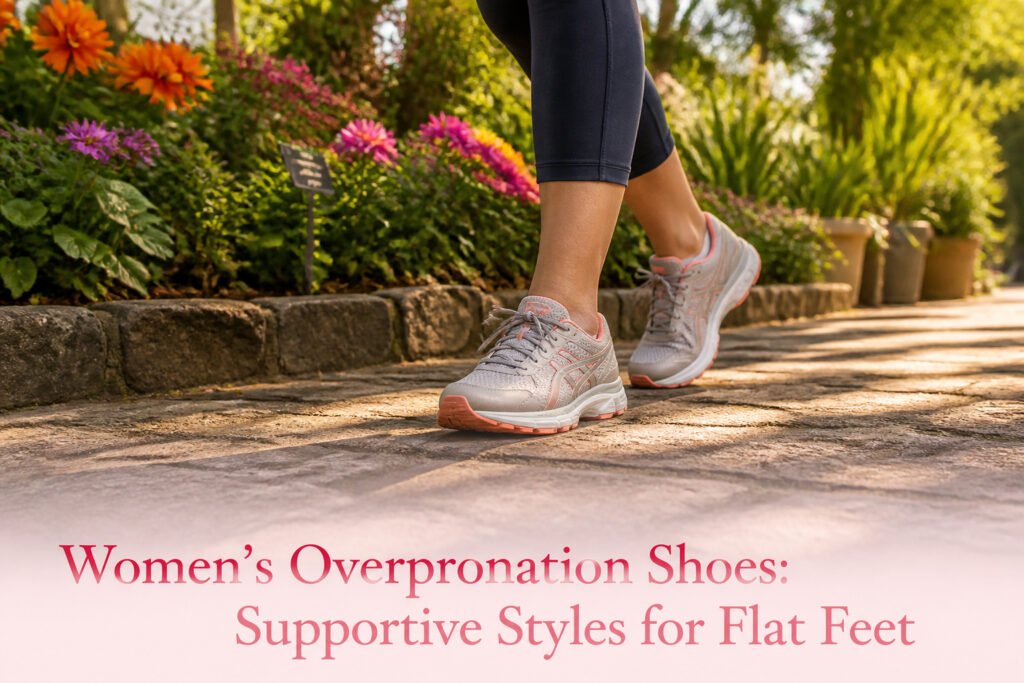
Women’s overpronation shoes are built to stop the inward roll of a flat foot past the fifteen-degree mark that normal gait allows.
The hard part is that support exists on a spectrum: motion control locks the foot rigid while stability trainers like the Brooks Adrenaline use GuideRails to step in only when collapse passes a threshold.
Knowing where you fall on that spectrum, through a gait analysis or your wear pattern, determines whether you need the Beast’s dense posting or end up fighting a shoe heavier than your condition requires.
1. Brooks Beast for Severe Overpronation

Motion control sits at the top of the support hierarchy for a reason.
Where stability shoes guide moderate overpronation, motion control locks the foot into position through a rigid medial post and a straight last built to stop severe inward rolling entirely.
The Brooks Beast is the clearest example of this category made for women, and it earns its reputation by being the most structured option you can buy over the counter.
That structure comes with trade-offs. The Beast is the heaviest daily trainer in the Brooks lineup, and the density of the midsole foam takes time to soften.
Most wearers need two to three weeks of short runs or walks before the shoe begins to flex naturally with their stride, and some never find it comfortable for all-day standing.
The rigidity that corrects severe overpronation also limits forefoot bend, which can feel awkward on stairs or inclines.
I would only point someone toward this shoe if they have been told they genuinely need maximum support, either through a gait analysis or repeated injury history with lesser shoes.
For severe overpronation, the Beast is the right tool; for moderate cases, the weight and break-in period are penalties without purpose.
2. Brooks Adrenaline for Moderate Overpronation

Brooks Adrenaline sits at the center of almost every conversation about women’s overpronation shoes, and that frequency of recommendation is itself worth trusting.
The shoe built its reputation as a stability trainer for runners with moderate overpronation, the kind of daily runner who logs regular miles but does not need the aggressive correction that heavier structures provide.
What separates the Adrenaline from older stability designs is GuideRails, a technology that functions differently than traditional medial posting.
Where conventional posting pushes the foot upward from the arch side with a dense foam wedge, GuideRails act more like bumpers along the heel, allowing neutral motion within a safe range while stepping in only when the foot collapses inward past that threshold.
For a buyer unsure whether her gait is mildly or moderately overpronated, this makes the Adrenaline a safer default: the shoe does not force correction where none is needed.
Against the Beast, Brooks’s severe-overpronation sibling, the Adrenaline carries less weight and bends more naturally through the forefoot.
The Beast adds denser posting and a stiffer platform for runners whose ankles roll dramatically; the Adrenaline keeps enough flexibility for tempo days and gym cross-training without sacrificing the support structure that matters on longer runs.
That balance explains why it appears across podiatry offices, running shops, and physical therapy recommendations more consistently than any competitor in the category.
3. Saucony Kinvara for Light Support

The Saucony Kinvara sits in an odd spot for flat-footed runners. It is built as a neutral shoe, not a stability model, yet some overpronators reach for it anyway and find it tolerable for shorter efforts.
The reason usually comes down to weight: the Kinvara is noticeably lighter than true support shoes, and that matters when you are doing tempo runs or interval work where a clunky trainer slows the turnover.
The risk is real, though.
Without the medial posting or firmer midsole edge that stability shoes use to slow inward collapse, the Kinvara leaves severe overpronators unprotected. I would not use it for long runs or daily easy miles where fatigue magnifies form breakdown.
The gamble makes sense only if your overpronation is mild and you are rotating the Kinvara in for speed days, not leaning on it as your only shoe.
If you finish runs with aching arches or inward knee drift, this is not the model to force.
4. Asics 21xx Series for Flat Feet

Asics keeps its stability line refreshingly straightforward once you know the code. The GT-2000 sits above the GT-1000 in cushion and support, both built for overpronation but separated by about a $30 gap and a step up in underfoot softness.
The GT-1000 handles daily miles with firmer response; the GT-2000 adds more FlyteFoam through the midsole, which is where Asics puts its lighter, more resilient foam so the shoe does not deaden after long runs.
Dynamic Duomax is the support piece that matters for flat feet. Asics places a denser foam wedge on the medial side, the inner edge where an overpronating foot collapses inward.
You feel it as subtle guidance rather than a hard post shoving your arch upward, which is why I point mild-to-moderate overpronators here before suggesting the Kayano.
That Kayano sits one tier above the GT-2000, priced higher and packed with more premium cushion, though the same Duomax logic runs through it.
For my money, the GT-2000 finds the middle ground for most women needing women’s overpronation shoes without paying for plush they will not notice on a 5K loop.
The GT-1000 works if your budget is tight and your mileage is moderate, but the firmer ride under a heavy pronation pattern can turn harsh past the 6-mile mark.
5. New Balance 990 with Orthotics

The New Balance 990 sits on a deep last with a removable insole, which makes it one of the more straightforward platforms for custom orthotics.
I look for three things when I’m matching a shoe to an insole: enough vertical room that the foot doesn’t get squeezed, an insole that actually lifts out instead of being glued flat, and widths that let the orthotic sit centered rather than crowding the edges.
This model checks all three, and it comes in sizes that run narrow to extra-wide, so the orthotic doesn’t become the whole fit story.
It is built as a lifestyle and walking shoe, not a running shoe. The cushioning leans stable rather than springy, and the heel counter holds its shape through daily wear rather than breaking down under miles of pavement.
For someone who needs arch support through a full day of standing or neighborhood walks, that trade works. For actual running, I’d point toward something with more flex and lighter foam.
The price runs well above entry-level support shoes, usually around $175–$200 depending on the colorway and whether you catch a restock.
That cost stings until you factor in how long the 990 tends to last and how many cheaper pairs get abandoned because the orthotic never sat right.
I still flag it as a real budget factor, though. If you’re not sure orthotics are permanent for you, it is a lot to spend on a test platform.
6. Aetrex and Vionic Arch Support

Aetrex and Vionic both started with podiatrists, not shoe designers, and that lineage shows in what they build.
The built-in orthotic footbed is the feature that matters: a molded contour meant to realign the foot rather than pad it, with materials that hold their shape through months of wear.
I consider these when someone needs all-day standing support more than running rebound.
You do give something up. The same rigid sole that stabilizes a flat foot through a hospital shift or retail floor feels harsh if you try to take it jogging.
Athletic brands engineer midsole foams for impact absorption; Aetrex and Vionic engineer for skeletal alignment, and the two goals use different math. Cork and firm EVA do not compress like Saucony’s PWRRUN or Brooks DNA.
Both brands shape their lasts for women’s feet rather than scaling down a men’s mold, which matters for heel width and arch placement.
Styling has improved from the clinical look of earlier years, though these still read as comfort shoes first.
For overpronation rooted in flat feet or plantar fasciitis, I find them more reliable than cushioned athletic options that let the arch collapse back inward.
7. Merrell Walking Shoes

Merrell builds its stability from trail DNA rather than medical geometry, and that distinction matters when you are choosing women’s overpronation shoes for everyday miles.
The Moab series anchors the line: a broad, grounded platform with a shank stiff enough to keep a flat foot from collapsing inward on uneven ground, wrapped in leather and mesh that shrugs off puddles and airport terminals alike.
I find this hiking-derived approach trades the springy roll-through of a running shoe for durability you can beat through seasons of dog walks and vacation cobblestones.
The midsole is firmer than what Brooks or ASICS engineer, which costs you some energy return but buys you a shoe that still feels structured after the foam in a typical trainer has gone soft.
For trail walking, travel, or any routine where water resistance outraces pace, that swap is the right call.
The Moab Ventilator breathes better in heat; the waterproof variants sacrifice some of that airflow for rain and slush. Neither is a running shoe, and treating them like one is the mistake that sends buyers back to the return pile.
Lace them for walking, expect a break-in period measured in days not hours, and they reward patience with years of service.
8. Custom Orthotics

Custom orthotics sit between the quick fix and the full medical route, and knowing which side of that line you’re on saves both money and arch pain.
Over-the-counter insoles like Superfeet or Dr. Scholl’s CustomFit line, which uses footmapping to match you to one of fourteen semi-custom options, work fine for mild overpronation or short-term relief.
I see them as a trial run: if the green or orange Superfeet help, you have your answer. If they make no difference, as some users find, that’s your signal to see a podiatrist.
The custom route means a gait analysis, a mold of your foot, and a device built to your pressure map.
Expect roughly $300–600 out of pocket, more if your insurance balks. What you get back is correction you can’t buy off the shelf, particularly if you have flat feet, plantar fasciitis, or asymmetry between your arches.
Here’s where people trip up: dropping a rigid orthotic into a neutral shoe does not create a stability shoe.
The shoe’s midsole still compresses however it was engineered to compress, and the orthotic fights that geometry instead of working with it.
You want a shoe with a removable insole and a straight or semi-curved last, something that accepts the orthotic without crowding your toes or tilting your ankle into a new problem.
Some combinations feel fine for a week, then the compensation shows up in your knee or hip. Test them on a treadmill or a returnable run before committing.
What Overpronation Means

Women’s overpronation shoes address a gait pattern most common in people with flat feet or very low arches, where the foot rolls inward too far and too long during each step.
Normal pronation absorbs shock as the outer heel strikes, then the foot rolls inward about fifteen degrees, the arch flattens slightly, and the toes push off.
In overpronation, that inward roll continues past the fifteen-degree mark, the arch collapses fully, and the big toe and second toe bear almost all the propulsion force.
This timing matters. The foot should be stable through midstance; overpronators stay mobile too late, so the ankle, knee, and hip twist inward with each stride.
Repeat that a few thousand times and the stress gathers in predictable places. Plantar fasciitis tops the list from the overstretched arch.
Shin splints come from the tibialis posterior muscle fighting to control the collapse. Runner’s knee and IT band syndrome follow as the kneecap tracks inward and the thigh rotates against the hip.
You can self-check two ways. The wet foot test shows the pattern: step out of the shower onto dark paper and look for a full footprint with little inward curve.
Video confirms the motion; set your phone at ankle height, walk toward it naturally, and watch whether your arch flattens completely and whether your knee drifts inward past your ankle.
How to Get Fitted

A gait analysis at a running store starts with watching you walk or jog, usually on a treadmill or across the floor, while staff study how your foot lands and rolls.
They may use slow-motion video or pressure-mapping plates to catch what the eye misses: whether your arch collapses inward, how far, and where your weight shifts.
Bring the shoes you already wear most, since their wear pattern tells the story your feet won’t. Pack any orthotics you use and the exact socks you run in; even a slight change in sock thickness alters fit.
Store staff matter because overpronation exists on a spectrum.
One runner’s mild roll needs different posting than another’s severe collapse, and the wrong stability level either wastes your money or leaves you injured. I would not buy women’s overpronation shoes online until I had that baseline.
Once you know your pattern and which brands match your foot shape, reordering the same model is straightforward. Before then, you are guessing with your knees and ankles on the line.
Arch Support and Why It Matters

Arch support in women’s overpronation shoes does not merely cushion; it interrupts a chain reaction.
When the arch collapses, the tibia rotates inward, the knee follows that rotation, and the hip compensates to keep you upright. Without intervention, that compensation becomes chronic strain.
The materials that actually stop this motion are specific. Dual-density EVA firms up the medial side of the midsole so the foot cannot roll inward past a controlled point.
A TPU shank adds torsional rigidity, keeping the shoe from twisting where the arch should stay level. Medial posts, denser wedges built into the midsole, act as a brake on that inward roll without blocking natural flex at toe-off.
Brooks builds these elements into the Beast and Adrenaline lines, scaling the support intensity to the runner’s need.
The Beast layers in maximum medial posting for severe collapse; the Adrenaline dials it back for moderate overpronators who still want some ground feel.
Saucony’s Guide 5 uses a lighter medial post for runners who found traditional motion control clunky, and the Asics 21xx series pairs its stability structure with structured insoles that replace rather than supplement the stock liner.
New Balance’s 990 works differently: its platform is neutral, but the volume inside accommodates aftermarket orthotics like Superfeet Green that provide the arch support externally.
The right combination depends on how far your arch collapses and whether you need that support built in or added after.
Frequently Asked Questions
What are the best shoes for overpronation?
The best women’s overpronation shoes are the Brooks Beast for severe cases, the Brooks Adrenaline for moderate overpronation, the Asics GT-2000 or GT-1000 for flat feet, and the New Balance 990 if you wear custom orthotics.
The Beast locks the foot in place with rigid medial posting, while the Adrenaline uses GuideRails that step in only when your foot collapses past a safe range.
The Asics 21xx series hits a sweet spot for most women, and the 990 works because its deep last and removable insole accept orthotics without crowding.
How do I know if I overpronate?
You overpronate if your foot rolls inward past fifteen degrees after heel strike and your arch collapses fully during midstance.
Two self-checks work: the wet foot test, where a full footprint with little inward curve on dark paper suggests flat feet and overpronation; or video yourself walking toward a phone set at ankle height to watch whether your knee drifts inward past your ankle.
A gait analysis at a running store with slow-motion video or pressure-mapping plates gives the clearest answer.
What should I look for in shoes for flat feet?
Look for dual-density EVA that firms up the medial midsole, a TPU shank for torsional rigidity, and medial posts that brake inward roll without blocking toe-off flex. The right shoe depends on how far your arch collapses.
Built-in support works for most; if you use orthotics, pick a shoe with a removable insole, enough vertical room, and widths that let the orthotic sit centered. The New Balance 990 checks all three for orthotic wearers.
Do overpronators really need stability shoes?
Severe overpronators need the rigid medial posting of motion control shoes like the Brooks Beast, and moderate overpronators benefit from stability trainers like the Adrenaline or GT-2000 that slow inward collapse without forcing correction where none is needed.
Mild overpronators might tolerate neutral shoes for short efforts, but rotating a neutral shoe for speed days while leaning on stability for daily miles is safer than going without support entirely.
The wrong stability level either wastes money or leaves you injured.
Can overpronation cause plantar fasciitis?
Yes.
When the arch collapses fully and stays mobile too late through midstance, the plantar fascia overstretches with each stride. Repeat that thousands of times and the tissue tears and inflames.
Shin splints follow from the tibialis posterior muscle fighting to control the collapse, and runner’s knee or IT band syndrome develop as the kneecap tracks inward and the thigh rotates against the hip.
Interrupting the chain with proper arch support stops the stress from gathering in these predictable places.