
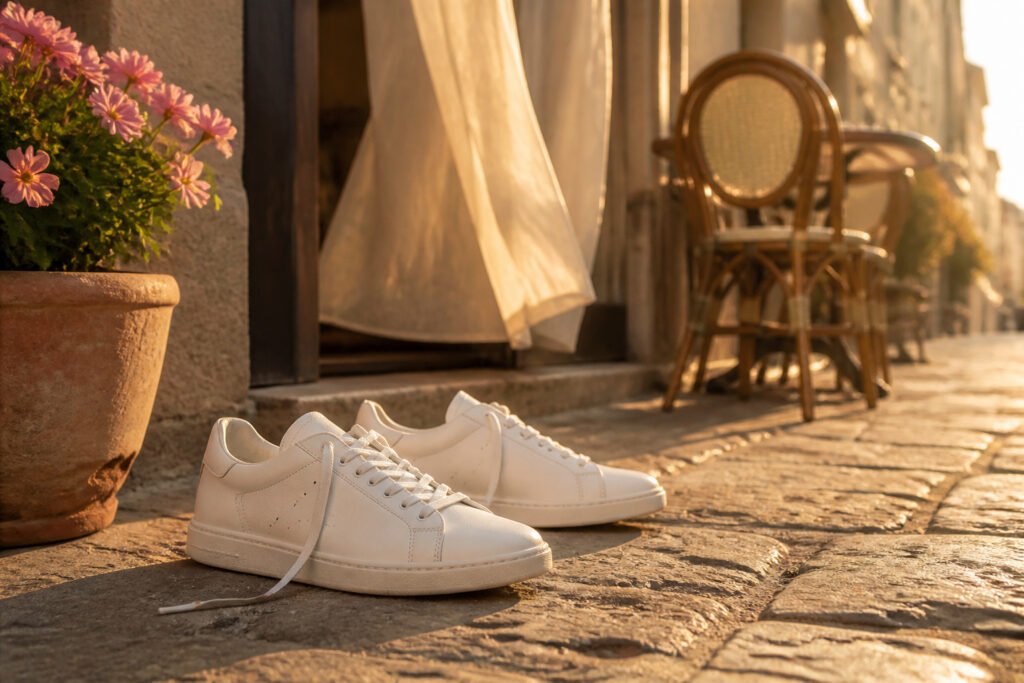
All white shoes are the one sneaker that earns shelf space year-round, but only if the upper material matches how you actually wear them.
Leather holds structure for years and wipes clean, while knit breathes in July but pills at the toe crease within a season.
The nine pairs below range from a $60 Vans slip-on to a $750 Margiela Replica, and the break-in week a full-grain court shoe demands is the price you pay for a shape that still looks deliberate at year two.
Converse Chuck 70

The Converse Chuck 70 keeps the silhouette that has defined casual footwear since the 1920s while fixing the one problem that kept the original from being a true daily driver.
At $95, you get the heavier canvas upper, the slightly higher rubber midsole, and the smaller toe cap that marked the best era of production in the 1970s, plus a cushioned insole that earlier versions never had.
I have worn both the standard Chuck and the 70, and the difference is immediate: the upgraded model feels substantial without looking trendy, and the retro black heel patch reads as intentional rather than default.
The canvas holds its shape better, the sole no longer feels like it is flattening against pavement after a month, and the whole shoe simply lasts longer.
High-top or low-top is the only decision you need to make. The standard Chuck still exists at a lower price, but the 70 earns its markup through materials you can feel and a wearing experience that finally matches the iconic look.
Reproduction of Found German Military Trainers

At $310, the Reproduction of Found German Military Trainers sit in a bracket where materials either justify the cost or they don’t.
These do. Italian leather, suede, and a mesh lining run through the upper, while rubber soles match the original West German Army spec down to the tread pattern.
The factory in Slovakia that builds them has turned out military-issue sneakers for generations, so the construction carries actual lineage rather than costume.
Military trainer heritage matters for daily wear in ways that show up after a month, not a day. The last is shaped for marching, which translates to a footbed that stays comfortable through long standing hours.
The leather breaks in rather than breaking down. The suede panels add grip where synthetic linings would let your heel slide.
The honest trade-off is weight and break-in time.
These are not featherlight knit runners, and the leather needs a week to soften. For the price, you are buying permanence: a shoe that looks cleaner at year two than bonded alternatives look at month six.
If your white sneaker budget stops at $150, the step up is real and the value depends on how many replacements you are skipping.
Reebok Club C Vintage

The Reebok Club C Vintage carries actual tennis heritage, not just the styling.
Released in 1985, the original Club C was built for court performance before it migrated to everyday wear, and that lineage shows in the proportions: a flatter sole profile and cleaner upper than most retro sneakers that merely quote the era.
What you are buying today is a deliberately aged reproduction, not a faithful reissue. The vintage treatment softens edges, yellows midsoles slightly, and generally makes the shoe look like it has already lived through a few summers.
That pre-worn finish lands differently on different people. For anyone who wants the 1985 silhouette without scuffing it in themselves, this is the shortcut.
For others, the effect reads as costume, and the "moodboard" quality GQ noted is real: these can look like you bought the aesthetic whole rather than built it.
At $79 (down from $90), the price sits below true archival reproductions and well below designer takes on the same idea.
The leather is comfortable enough for daily wear, and the shape pairs naturally with relaxed pants, which is where most Club Cs spend their time now.
You lose some specificity. This shoe commits to a particular retro mood in a way that a plainer white sneaker does not.
Vans Premium Slip-On 98

The Vans Premium Slip-On 98 lands at $60 and earns its place by doing one thing better than almost any laced competitor: disappearing on your feet.
The Premium line swaps standard Vans construction for beefed-up cushioning and a more substantial canvas upper, which means the shoe gains structure without gaining much weight.
I consider that a fair trade for the extra twenty bucks over the mainline version.
The slip-on format reads differently depending on your outfit. With baggy chinos and a plain tee, it leans coastal and effortless; with cropped pants or jorts, it picks up a throwback skate reference that feels deliberate rather than lazy.
That same lack of laces limits you in formal settings, no question. But for warm-weather days when you are already dressing down, the absence of hardware becomes the point.
The rubberized sole handles light rain well enough, though I would not expect it to outlast a stitched cupsole from a dedicated heritage brand.
Salomon XT-6

The Salomon XT-6 lands at $180 with a construction that reads aggressive on paper: nylon mesh upper, sleek synthetic panels, and a quick-lace system that cinches without tying, all sitting on a lugged sole built for craggy mountainsides.
The glacial white colorway keeps the look clean enough that the technical elements register as texture rather than sport.
I keep coming back to whether the trail-ready grip and support justify themselves on pavement. The quick-lace system saves seconds, but city wear does not punish a shoe the way a descent does.
The aesthetic carries most of the weight here; the iced-out panels and fierce-looking sole turn heads at brunch in ways a simpler runner would not.
For women building a wardrobe around pieces that work hard across occasions, the XT-6 asks you to pay for performance you may never stress-test.
It wins if you want one shoe that can handle a light hike and still look deliberate with tailored trousers. Skip it if your white sneaker spends its life on sidewalks and you would rather put that $180 toward leather.
Nike Cortez Leather

Bill Bowerman introduced the Nike Cortez in 1972 as a lighter, sleeker running shoe, and the same year saw athletes wearing it at the Olympics.
The leather version swaps that original nylon for a material that holds shape longer and reads more deliberately retro, almost varsity jacket, rather than pure sport.
At $90, the Cortez Leather sits in a sweet spot where throwback energy meets actual versatility. Air Force 1s lock themselves to New York in a way the Cortez simply does not, this shoe travels better across regions and dress codes.
The leather upper works with cropped trousers and a clean sock, or with a full length denim that breaks right at the eyelet row, but steer clear of anything too technical or the shoe starts looking costume.
The foam midsole is not cushioning you will mistake for modern running tech, but that is the point: this is a shoe for walking and standing, not miles.
The trade-off is the break-in; leather this grade needs a week before it softens to your foot. Buy your true size and expect the toe box to feel generous at first, it settles.
Adidas Samba LT

At under $100, the Adidas Samba LT lands where most clean white sneakers either cheap out on leather or jump to twice the price.
The LT distinguishes itself from standard Sambas by keeping the indoor-soccer profile, born in 1949 when Adolf Dassler designed the original as a training tool for footwork in muddy conditions, but refining the proportions for everyday wear.
Smooth leather and suede uppers split the difference between sporty and casual without committing fully to either camp.
The shape has persisted for 75 years because it actually solves a problem: low enough to wear with cuffed denim, structured enough not to collapse under a mid-weight trouser. Ubiquity is the trade-off.
Most women I know who own a pair bought them after the hype cycle had already peaked, which means the resale anxiety has cooled and the shoe gets judged on whether it works with what they already own.
It usually does.
I would not chase limited drops for this silhouette; the standard LT in full grain leather is the value, and the color that holds up best to scuffs is the off-white rather than optic white, though that distinction matters less on a shoe this easy to clean.
Maison Margiela Replica

The German Army Trainer, or GAT, dates to the late 1980s, and the Margiela version at $750 is the rare upscale homage that earns its place.
The leather arrives buffed but not glossy, the suede stays supple without feeling fragile, and the whole shoe reads elevated enough for a casual office and restrained enough for after.
Other brands have tried the silhouette, and vintage originals still circulate, yet Margiela’s construction justifies the tariff where most charge for the name alone.
The deliberate replica concept, after all, is the statement: taking an anonymous utilitarian design and reissuing it as luxury goods.
Whether the materials and build fully support the price or the price supports the statement depends on what you value. I lean toward the former on craftsmanship, though I will not pretend the margin is not also the message.
Moonstar Gym Classic

The Moonstar Gym Classic lands at $167, a price that only makes sense once you handle the shoe. Moonstar has built footwear in Japan for generations, and the vulcanized rubber sole is where that history shows.
The process bakes the rubber under heat and pressure until it fuses directly to the canvas upper, creating a bond that stays tight for decades rather than months.
The result looks like a standard gym shoe from a distance, but the density of the sole and the even tension across the upper give it a weight and structure that cheaper reproductions skip.
Heritage-style sneakers at lower prices usually cut the vulcanization step or move production elsewhere, and the difference is in how the shoe breaks down over time.
The Moonstar keeps its shape and its grip where glued soles start to separate. For $167, you are paying for that longevity and for Japanese manufacturing wages, not for a logo.
The question is whether you need a shoe that outlasts its laces, or whether a less expensive pair that looks similar for two seasons is enough.
I would buy the Moonstar if I wore all white shoes three or more days a week; for occasional use, the premium is harder to justify.
Why White Sneakers Stay Relevant

A clean white sneaker reads as finished even when the rest of an outfit is thrown together.
I reach for mine on mornings when I need to look pulled together without deciding much: the leather or knit upper keeps the line crisp against dark denim, and the same pair transitions to chinos and a pressed shirt without looking underdressed.
That range, from weekend errands to a casual Friday that might run into drinks, is what makes them the one shoe that earns its shelf space year-round.
The comfort side matters as much as the versatility.
Cushioned soles and flexible outsoles that move with your stride mean you are not trading an aching foot for a clean look, whether you are walking to work or standing through a long afternoon.
I think of white sneakers as foundational, not finishing: they ground an outfit in something intentional, and they do it without demanding attention.
What the Materials Actually Do

The upper of an all white sneaker determines most of how it will live with you.
A lightweight knit breathes in July and weighs next to nothing on your foot, but it will soften and lose shape faster than anything else in your closet.
I have watched mesh uppers pill at the toe crease within a single season, which is the trade you make for that barely-there feel.
Leather, by contrast, starts stiffer and asks for a break-in week. It holds structure for years, scuffs rather than tears, and cleans back to presentable with a damp cloth.
The weight difference matters on a long day, though: a full-grain leather court shoe runs noticeably heavier than its knit counterpart, and that load adds up if you are on concrete for hours.
The midsole is where comfort actually happens. PU and EVA foams compress differently; the former rebounds longer but costs you responsiveness, while the latter feels lively early and flattens out within months.
A brand that layers densities, softer at heel strike and firmer at toe, is making a shoe you can wear past 5 pm without regretting it.
Rubber outsole thickness is the last variable worth your attention. Thin saves weight and grounds the foot for driving or cycling; thick absorbs shock and buys you another year before the tread goes bald.
How Retro and Modern Designs Read Differently

The 1970s running shape that still dominates white sneaker racks started with a simple formula: a slim last, a low foxing, and a leather upper that creased into a map of your foot.
That silhouette signals intention without effort, and it pairs with everything from raw denim to summer dresses because it reads as finished rather than athletic.
Modern technical silhouettes flip the script. Mesh panels, exaggerated soles, and TPU cages announce that the shoe is doing work, which makes them read as deliberate styling rather than a default choice.
I reach for retro lines when I want the rest of an outfit to talk, and technical shapes when the shoe itself is the punctuation mark.
You give up some comfort for versatility: a padded collar and foam midsole feel better at mile three, but a thinner profile sits cleaner under a tapered trouser.
Retro designs win for repeat wear across seasons; modern builds earn their closet space when you need one statement piece to carry a minimal outfit. Neither is wrong, but they ask different things of the rest of your wardrobe.
Frequently Asked Questions
What are the best white sneakers for men?
The nine standouts are the Converse Chuck 70 at $95, Reproduction of Found German Military Trainers at $310, Reebok Club C Vintage at $79, Vans Premium Slip-On 98 at $60, Salomon XT-6 at $180, Nike Cortez Leather at $90, Adidas Samba LT under $100, Maison Margiela Replica at $750, and Moonstar Gym Classic at $167.
Each earns its place through specific materials or construction rather than branding alone.
How do I style white sneakers?
Match the silhouette to the rest of your outfit. Retro designs like the Chuck 70 or Club C sit cleaner under tapered trousers and let your clothes do the talking.
Technical shapes like the XT-6 work as a statement piece with minimal outfits. The Cortez Leather travels across regions and dress codes, though it clashes with technical fabrics.
What makes white sneakers a wardrobe staple?
They read as finished even when the rest of your outfit is thrown together, and they ground a look without demanding attention.
One clean pair handles weekend errands through casual Fridays that run into drinks, year-round, without trading an aching foot for the look.
Where can I buy all white shoes?
The pairs reviewed here are available direct from brands like Nike, Adidas, Converse, and Vans, or through retailers including Nordstrom, Mr Porter, Amazon, and Famous Footwear. Specialty Japanese imports like Moonstar ship through select importers.
Are all white shoes still in style?
Yes. They have never actually cycled out: the same silhouettes from the 1970s and 1980s still dominate racks, and brands keep producing them because the demand stays constant.
What shifts is which specific model is having a moment, not the category itself.
What are the popular white shoes called?
The names that come up most often are the Converse Chuck 70, Nike Air Force 1, Adidas Samba, Vans Slip-On, and Nike Cortez.
In fashion circles the German Army Trainer, especially the Margiela Replica, carries its own name recognition. Each of these has been in production for decades or directly references a decades-old design.