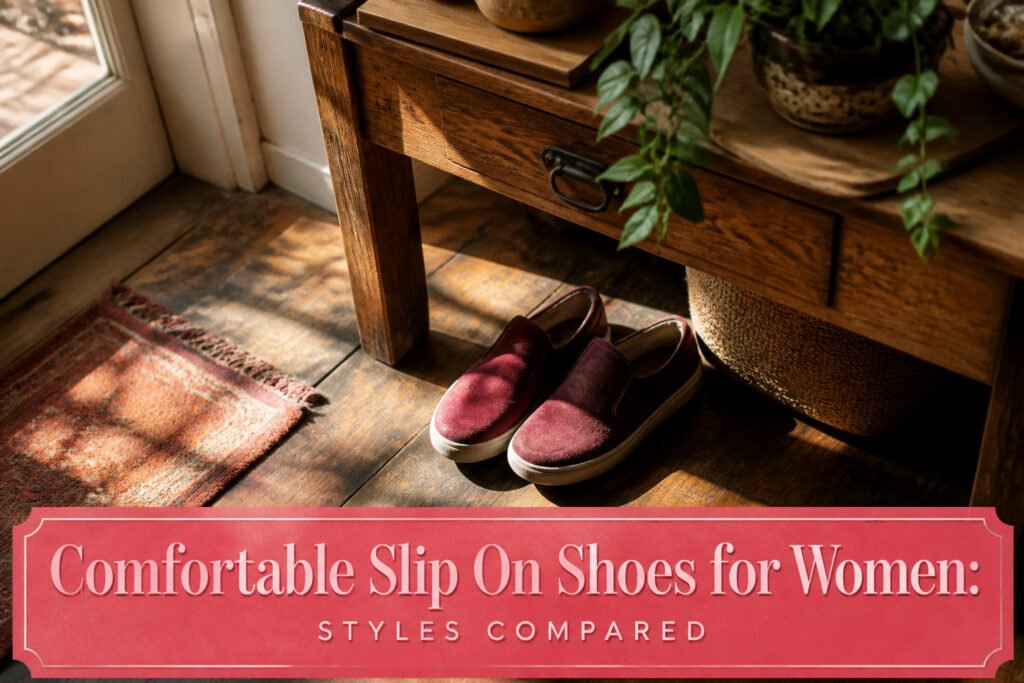
Comfortable slip-on shoes for women are footwear built to go on without laces, buckles, or straps, then stay on through a full day of walking, standing, and quick errands.
"Slip-on" covers everything from foam garden clogs to leather staples that cost close to $200, and what actually keeps your feet happy shifts dramatically with the job you hand the shoe.
Crocs Classic Clogs hit $49.99 for a single molded piece of EVA that drains through its own ventilation holes, while the SAS Me Too runs $198.95 for hand-sewn Texas construction with three-point pressure redistribution meant for diabetic feet.
You are not buying the same product twice.
1. Crocs Classic Clogs

The molded EVA construction on the Crocs Classic Clogs is what separates them from knockoffs that look similar but feel wrong within an hour.
At $49.99, you’re paying for a single piece of foam that keeps the weight barely there and bounces back instead of compressing flat.
That matters when you’re on your feet through a full shift, and it matters more when you’re rinsing dirt or sand off in the sink because the shoe has no seams or fabric to trap moisture.
The ventilation holes double as drainage, which is why these became the default for garden work and beach days before they became a fashion item.
I wouldn’t wear them on polished floors; the tread is shallow and the foam can slide where a rubber outsole grips. For concrete, grass, or anywhere you’re standing in one spot, the give in the sole saves your knees.
Aesthetics take a hit: the shape is bulky, the colors are loud, and "slip on" here means no heel counter at all, so your foot leaves the shoe as easily as it enters.
If you’re walking fast or carrying weight, that’s a problem. For slow errands and household chores, it’s the feature.
2. Skechers GoWalk

The Skechers GoWalk lands at $92.00 and earns its place on this list through a sole unit built entirely around walking mechanics.
The ULTRA GO midsole delivers responsive cushioning that rebounds with each step rather than flattening out by noon, and the Air Cooled Goga Mat insole adds ventilation that matters on summer sidewalks.
At roughly seven ounces per shoe, the slip-on construction disappears on the foot in a way that structured sneakers simply do not.
That same minimalism becomes the limitation. The upper is engineered mesh with no heel counter to speak of, so lateral stability is traded away for the weight savings.
I would not reach for this shoe if my day included uneven terrain, standing in place for hours, or any need for arch correction beyond what the insole provides.
For pure walking on predictable surfaces, the cushioning system works as advertised. For anything else, the lack of structure shows.
3. Teva Ember Moc

A ripstop upper and collapsible heel make the Teva Ember Moc the shoe I grab when I do not want to choose between lounging and leaving the house.
At around $50, it sits in that odd middle space: more structure than a slipper, less commitment than a trail runner.
The rubber outsole with real tread matters more than it sounds. Damp pavement on a quick pharmacy run turns dedicated slippers into a hazard, and this thing handles it without the clomp of a full hiking sole.
I think of it as a lounger-hiker hybrid for errand days, not actual miles. The heel folds down for easy entry, pops up if you want a little more hold.
It is not waterproof, not supportive enough for real trails, and the look is camping-weekend casual at best. For someone who works from home and steps outside three times a day, that trade-off usually wins.
4. Dansko Professional

The Dansko Professional runs $144.95 for the stapled clog in Antique Brown/Black Oiled Leather, and that price buys you a wide toe box and arch support firm enough that nurses and teachers still put up with the weight.
The rocker bottom is the detail that matters: where flat soles let your foot slap down and push off in two distinct shocks, the curved sole rolls you through each step, shortening the stride slightly and cutting the load on your heel and forefoot.
After ten hours on linoleum, that gait change is the difference between functional and miserable.
The Honey Distressed colorway pushes to $154.95, and the leather treatment matters less than the fit. These are heavy shoes, and they look it, but the people who need what they do stopped caring about that years ago.
5. Birkenstock Boston Clog

The soft footbed Boston runs $165.00, which is the price that stings before you know whether the shoe fits your foot at all.
The cork-latex core and suede lining mold to your shape, but only after a break-in period that can last two or three weeks of consistent wear.
During that window, the raised toe bar sits under your metatarsals and actively spreads your toes with each step. I think that feature is what separates people who become cult devotees from people who pawn theirs off within a month.
The toe bar works only if your foot is the right shape for it.
A low arch or a short big toe means the bar presses in the wrong place, and the suede lining, which starts plush, compacts where pressure is wrong rather than right.
The Boston demands a fairly neutral to slightly high arch and a longer second toe or at least a big toe that reaches far enough to anchor the flex.
Without that geometry, you are paying premium prices for a shoe that never stops feeling like it is correcting something that does not need correction.
For women whose feet match the last, the $165.00 soft footbed version becomes the slip-on you reach for regardless of occasion.
For everyone else, the Boston is a costly mistake disguised as a practical choice. The 4.5-star aggregate rating on retail listings reflects that split exactly: five stars from the matched, lower scores from the mystified.
6. Orthofeet

Orthofeet sits at the medical end of comfortable slip on shoes for women, with prices running $99.95 to $165.00 and a core mission of accommodating feet that standard brands simply won’t.
The Louise lands at that $99.95 floor, while the Carmel peaks at $165.00, and most models cluster between roughly $115 and $145.
Every pair ships with orthotic insoles and extra depth built in, plus adjustable straps or stretchable uppers designed specifically for bunions, hammertoes, and other conditions that make typical shoes unwearable.
Where these outperform fashion brands is in the engineering: the insoles are anatomical, the toe boxes actually expand, and the soles are built for stability rather than trend cycles.
Someone with diabetes-related foot sensitivity or advanced arthritis will notice the difference in the first hour of wear.
You can spot the compromise from ten feet away. Panels are wider than sleek, colors run to beige and black rather than the season’s palette, and the silhouette reads clinical rather than something picked for looks.
For a woman whose dress code is business casual and whose feet are healthy enough for regular widths, the styling gap is real.
For a woman who has already returned three pairs of Clarks because the bunion pressure made them unwearable, that gap disappears entirely.
7. Clarks

Ayla Low and its siblings carry the kind of underfoot engineering that makes a nine-hour desk day survivable.
Cushion Soft padding sits under an OrthoLite footbed, a pairing that absorbs the hard lobbies and concrete garage walks office life throws at it.
The leather uppers break in without the cruelty of a blister week, and the silhouette reads polished enough for a client lunch without trying to be interesting.
Where Clarks stumbles is weight and flexibility against newer builds. The same foam that saves your heels on marble floors feels dense compared to the injection-molded midsoles coming out of athletic brands now.
The outsole grips but does not rebound; after a year of daily wear the compression sets in and the shoe starts feeling like what it is, a heritage piece rather than a recovery tool.
I still reach for them when the outfit needs to signal reliability, not edge. For women building a capsule wardrobe around blazers and tailored trousers, the Clarks slip-on earns its shelf space as the safe Monday choice.
You carry a slightly heavier step in exchange for leather that still looks respectable at the five-year mark, which is farther than most lightweight competitors will take you.
8. Ecco

Danish direct-injection polyurethane construction gives Ecco soles a density gradient that holds up to daily walking mileage better than standard EVA.
The midsole and outsole bond in one shot, so there is no glue line to shear apart after eighteen months of pavement.
That process costs, which is why most Ecco slip-ons sit above $150 and justify the price only if you wear them most days.
The leather uppers start stiff and darken quickly at crease points, but that patina reads as character rather than wear.
Synthetic uppers in the same price bracket stay cleaner-looking longer yet trap heat and split at flex zones within two years.
Full-grain leather, oiled occasionally, outlasts them and molds to the foot in a way polyurethane never will. For someone logging real miles, the math favors leather’s longevity over the lower maintenance of synthetics.
9. Allbirds

Merino wool uppers feel soft against bare skin and regulate temperature better than most synthetics, though breathability in real heat has limits; the weave traps warmth that becomes noticeable past 75 degrees.
The sugarcane-based EVA sole is light and noticeably cushy for walking, but it compresses faster than traditional running midsoles and offers less lateral support for all-day standing.
Odor resistance is where this construction genuinely delivers: the wool fibers wick sweat and resist bacterial growth, so they stay fresher longer than canvas or standard knit uppers.
I see these as a second pair for most wardrobes, not the foundation.
The relaxed fit and minimal structure work for errands and casual Fridays, yet the narrow toe box and lack of adjustable closure rule them out for wide feet or long shifts on concrete.
Pair them with travel days or light weekend wear where convenience matters more than arch support.
10. Altra

Altra builds around a zero-drop platform, meaning the heel and forefoot sit at the same height off the ground rather than the heel being elevated.
The toe box follows what the brand calls FootShape, designed to let toes splay naturally instead of being squeezed to a point.
That geometry rewards wide forefeet and anyone whose feet spread under load, but it asks something back: calves and Achilles tendons conditioned to heel-drop shoes need weeks to adjust, and rushing that period invites strain.
The biomechanical logic is sound, yet Altra turns up less often in general comfort roundups than brands like Clarks or ECCO.
Part of that is specialization. The construction reads running-first, and the aesthetic does not slide easily into office or dinner contexts where women want one shoe to carry the day.
Price sits above the casual impulse buy too, and sizing often runs small enough that half-size-ups are common advice.
For plantar fasciitis sufferers and travelers on their feet all day, the benefit justifies the hunt, but the brand demands more homework than slip-on shoppers usually want to do.
11. Sanuks

Sanuks trace back to a Southern California surf brand, and that DNA still shows in every pair. The uppers are soft canvas or knit, the sole folds nearly flat, and the whole shoe weighs next to nothing.
The yoga-mat footbed is the real draw: actual repurposed yoga mat material underfoot, giving a cushioned, beach-casual feel that breaks in within hours, not days.
That unstructured build is what makes them ideal for hostel floors, airport security lines, and stuffing into a carry-on side pocket. They slip on without hands and compress where stiffer shoes would fight back.
The same flexibility becomes the ceiling. Without a real midsole or heel counter, the footbed flattens out under sustained walking, and the loose fit lets your foot slide around on uneven ground.
I would pack them for a city weekend or beach week, but I would not count on them for a full day of museum miles or cobblestones.
12. SAS Me Too Adjustable Comfort Shoe

Hand-sewn construction at $198.95 puts the SAS Me Too in a different category than the molded options most of us default to.
The Texas-made build uses Tripad cushioning, a three-point system that redistributes pressure away from the heel, ball, and arch instead of flattening evenly like standard insoles.
For diabetic or neuropathy patients, that targeted support matters because loss of sensation means damage happens before pain registers.
The adjustable strap system closes with hook-and-loop rather than elastic, so the fit widens or narrows through the day as feet swell.
I see the value here as preventive: one ulcer avoided pays for several pairs, and Medicare-approved therapeutic shoes often run higher still.
Looks are where you lose out. These read clinical, not casual, and the 4 out of 5 stars from 179 reviews on Zappos suggests buyers know what they’re getting, functional footwear that prioritizes foot health over versatility.
For someone who needs certified depth and interiors without seams, that specificity justifies the cost. For the average shopper seeking one comfortable slip-on to pair with multiple outfits, the price and look are harder to absorb.
What Comfort Features Actually Do

Memory foam compresses under pressure and rebounds slowly, which spreads your body weight across a wider surface and reduces peak pressure at the heel and ball of the foot.
That makes it the right choice for metatarsal pain, the burning ache that builds across the forefoot after standing for hours.
Arch support works differently: it is a shaped insert or molded midsole that prevents the medial arch from collapsing inward on contact with the ground.
When the arch flattens, the heel tilts and the knee rotates, so proper support redirects the force of heel strike up through the ankle and leg in a straighter line. A wide toe box solves a simpler mechanical problem.
Standard lasts taper toward the front, squeezing the metatarsal heads together and forcing the big toe toward the second; a broad forefoot lets the toes splay naturally on push-off and prevents the numbness and joint compression that come from lateral pressure.
Each feature addresses a distinct failure point, and most women need only one or two, not all three.
A cushioned flat with memory foam does little for overpronation, just as a structured arch without forefoot room will still pinch at the bunion.
Price Tiers That Match Your Use

At $50, man-made uppers and glued construction dominate. The Easy Street Chive sits here at $39.75 clearance, with croco-embossed faux leather, a 1.5-inch block heel, and padded arch support that owners compare to sneaker comfort.
It works for occasional wear, but the materials will crease and the bond will fatigue faster than stitched alternatives.
Between $50 and $100, you find better lasts and some leather components.
This is where the Strategist’s under-$100 loafer picks land, with 40% off bringing solid construction into reach. The step up shows in heel counters that hold shape and outsoles that don’t go slick in six months.
| Tier | Construction | Longevity | Example from list |
|---|---|---|---|
| ~$40–$50 | Man-made upper, glued sole | 1–2 seasons | Easy Street Chive |
| $50–$100 | Partial leather, mixed construction | 2–3 years | Strategist fall loafers |
| $100–$150 | Full leather, stitched sole or welt | 4–6 years | n/a |
| $200+ | Premium leather, resoleable | 8–12+ years | n/a |
I stop recommending around $150 unless you wear one pair near-daily.
The cost-per-wear math only favors the premium tier when mileage is high; for a rotation of three or four pairs, the $50–$100 zone hits the balance of comfort, replaceability, and actual use.
Sizing for Wide Feet and Specific Conditions

Width markings on slip-ons are not standardized the way athletic widths are, so a medium in Clarks often fits like a wide in Altra because of how each brand builds its last.
Altra deliberately engineers extra forefoot room for natural toe splay, while Clarks tends toward a more traditional silhouette that still accommodates wider feet better than most dress-shoe makers.
ECCO sits somewhere between, with generous European lasts that reward sizing down rather than seeking a wide model.
For plantar fasciitis or bunions, the choice between sizing up and choosing a wide version depends on where the pressure sits. A half-size up adds length everywhere, which helps if your toes are cramped but can leave the heel sloppy.
A true wide model keeps the heel counter in the right place while opening the forefoot. Travelers with wide feet sometimes order two sizes from Zappos to compare, because a slip-on has no laces to compensate for a loose fit.
The general rule is, size up for length problems, choose wide for girth problems, and never do both unless the brand runs notoriously small.
From Desk to Trail and Back

Versatile comfortable slip on shoes for women matter most when your day refuses to stay in one lane.
The Teva Ember Moc builds its upper like a sleeping bag for your foot: quilted ripstop with a collapsible heel you can fold down or pull up.
I take it as a camp shoe that parks itself under a desk without looking like you gave up.
Crocs work the same double shift, though the price of that cushioned footbed is a silhouette most people either love or tolerate; I keep them for wet grass and airport security lines, not dinner reservations.
Ecco lands closer to the middle, with full-grain leather that creases instead of cracking and a sole stiff enough to push through gravel but not so stiff you notice it on carpet.
None of these replace a real hiking boot for loaded ascents, but all handle a three-mile loop and a cross-country gate without changing.
What separates them is where each draws the line: the Ember Moc quits at formal settings, Crocs at any attempt at polish, and Ecco at deep water crossings. Choose based on which failure you can afford.
Frequently Asked Questions
What are the best comfortable slip-on shoes for women?
Crocs Classic Clogs, Skechers GoWalk, Teva Ember Moc, Dansko Professional, and Birkenstock Boston Clogs all earn spots for different use cases.
Crocs win for wet conditions and household chores, Skechers for pure walking on predictable surfaces, Teva for lounging and quick errands, Dansko for long shifts on hard floors, and Birkenstock for women whose foot geometry matches the cork-latex mold.
How much should I spend on comfortable slip-on shoes?
The $50 to $100 range hits the balance of comfort, replaceability, and actual use for most shoppers.
At $50 you get man-made uppers and glued construction; between $50 and $100 you find better lasts and some leather components. Spending above $150 only makes sense if you wear one pair near-daily, since cost-per-wear math favors premium tiers only when mileage is high.
Are there specific brands known for comfort?
Altra builds around a zero-drop platform and wide toe box for natural splay, SAS hand-sews tripad cushioning for diabetic and neuropathy needs, Clarks pairs Cushion Soft padding with polished silhouettes for office wear, and ECCO uses Danish direct-injection polyurethane that bonds midsole to outsole without glue lines.
Each specializes in a different comfort problem rather than competing for the same foot.
What slip-on shoes do podiatrists recommend?
Orthofeet and SAS sit at the medical end, with anatomical insoles, expandable toe boxes, and interiors without seams designed for bunions, hammertoes, diabetes-related sensitivity, and arthritis.
The SAS Me Too at $198.95 uses a hook-and-loop strap system that adjusts as feet swell through the day, while Orthofeet models cluster between $115 and $145 with similar engineering goals.
Which brand has the best slip-on shoes?
No single brand dominates every category. Skechers GoWalk leads for lightweight walking at $92, Dansko Professional at $144.95 wins for long hours on linoleum with its rocker bottom, and ECCO above $150 justifies the price only if you log real miles most days.
The best brand is the one whose construction matches your actual day, not the one with the highest rating in a vacuum.