’90s women’s shoes were defined by a single tension: the decade wanted height and edge without the discomfort that usually came with both.
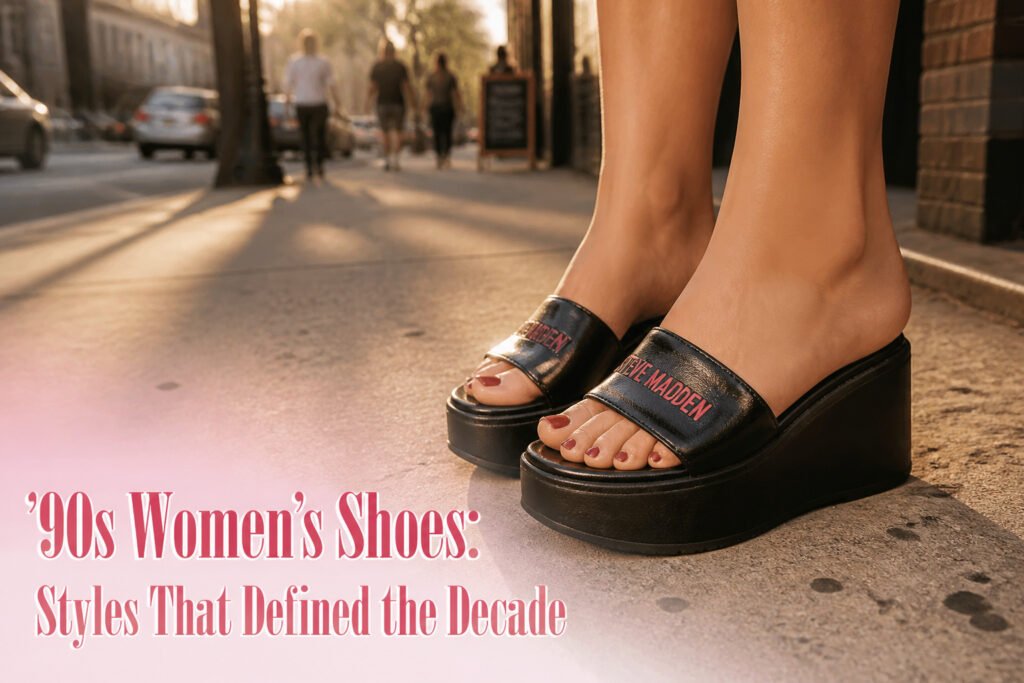
The Steve Madden Slinky Slide solved this for millions of teenagers, a thick-soled platform that read as dressy enough for going out but padded enough for everyday wear. That same formula still fills summer collections three decades later.
1. Platform Sandals

Platform sandals had already existed for decades before the ’90s got hold of them, but the decade pushed them to extremes that made the style impossible to ignore.
In 1993, Vivienne Westwood sent models down the runway in sky-high platforms for her Anglomania collection, a moment that became fashion history when Naomi Campbell tripped in them during the London show.
The Spice Girls carried the look into mainstream culture, performing and appearing in stacked heels that defined their visual identity.
For most American teenagers and twenty-somethings, though, the platform that actually mattered was more accessible: Steve Madden’s Slinky Slide, a thick-soled slip-on that nearly every girl owned in some form by the late ’90s.
Madden recently brought it back with a 2.5-inch heel and cushy footbed, which explains why the original worked so well for so many occasions.
The height read as dressy enough for going out, but the slide format and padding kept it casual enough for everyday wear in a way that stilettos never managed.
Today the flatform descendants of that same idea fill summer collections because the formula still solves the same problem: extra inches without the discomfort of a narrow heel.
2. Square Toes

Square toes were the defining silhouette of ’90s women’s shoes, and they showed up almost everywhere: pumps, flats, ankle boots, knee-high boots. The shape was a deliberate departure from the sharp, sky-high pointed toes that dominated the ’80s.
Where those earlier styles read as aggressive and overtly sexy, the square toe signaled restraint, minimalism, and a kind of borrowed-from-the-boys practicality that fit the decade’s broader shift toward pared-down dressing.
A square toe adds visual weight to the foot, which sounds like a drawback until you see how it anchors a pair of straight-leg jeans or a slip skirt.
The proportion works because it echoes the clean lines of ’90s tailoring rather than fighting them.
Designers like Daniel Lee at Bottega Veneta brought the shape back in 2019, and it has stuck around as a contemporary option rather than a strict vintage reference.
Rag & Bone’s Colt Sandal, which originally ran $375 and later hit sale at $150, is one example of how the style has been updated with modern materials while keeping that same blunt-toed geometry.
The square toe is polarizing, and always has been. Some women find it clunky; others appreciate that it leaves room for actual toes.
In the ’90s, that comfort-adjacent functionality was part of the appeal. The decade was not interested in the kind of suffering-for-fashion that pointed toes often required.
3. Combat Boots

Combat boots earned their place in ’90s women’s shoes by following a path from Seattle stages to runway controversy.
The utilitarian look that bands like Nirvana and Pearl Jam wore on stage, flannel paired with rugged lug soles and lace-up uppers, caught the attention of young designers including Marc Jacobs.
His grunge-inspired Perry Ellis spring ’93 show got him fired that same year, which tells you how unwelcome the subculture felt to fashion insiders at the time.
The style crossed over anyway. Dr. Martens put the look on the map, and their 1460 boot won Shoe of the Year at the 2019 Footwear News Achievement Awards, a full two decades after the decade that made them.
I take that award as proof that what started as punk and grunge signaling now reads as practical edge for everyday wear.
Several brands have since built combat boots into their collections, but the original silhouette still carries the association: subculture origin, mainstream arrival, and enough durability to outlast both.
4. Mary Janes

The Mary Jane had already been a girlhood staple for seventy years when the ’90s got hold of it.
The decade kept the single strap and rounded toe, but added chunky soles and hardware that turned schoolgirl innocence into something you could wear with a baby doll dress or a pantsuit.
Alicia Silverstone wearing them as Cher Horowitz in Clueless in 1995 sealed the look. After that, teens and women alike bought into the contrast: sweet shape, but heavy enough to ground an outfit rather than float away from it.
The shoe worked because it could read as casual slip-on or dressier option depending on what you paired it with, and that flexibility made it last.
Designers have kept reviving the form; Prada put models in strappy Mary Janes for spring 2020. The Yoox listing for Topshop’s Ace Black Chunky Mary Jane at $60 shows the formula still sells: closed toe, single strap, sole with weight to it.
5. Strappy Sandals

Strappy sandals arrived as the quiet correction to the ’80s platform and neon overload. Thin leather straps, usually two or three crossing the foot, replaced the heavy hardware of the previous decade.
I see them most often in flat versions for day and a modest heel for evening, almost always in black, tan, or a soft metallic that reads as neutral under dim lights.
The heel height rarely topped two inches, which meant you could wear them through a dinner without the arch ache that higher styles brought on by 10 pm.
They worked because the rest of the outfit was doing the same stripped-back thing: a slip dress, maybe a cropped cardigan, no competing statement pieces.
The trade-off was support. One narrow strap across the instep does not hold a foot steady on cobblestone or a grassy lawn, so you chose your venue before you chose the shoe.
6. Chunky Trainers

Chunky trainers sit at the center of almost every current ’90s revival outfit, and the silhouette has not softened since its first run.
New Balance built the original template: the 624 Cross Trainers are widely considered the first true dad sneaker, and the bulk that defined them then still reads as deliberate now.
Synthetic mesh and leather uppers sit on plush midsoles with non-slip rubber outsoles, a construction that straddled athletic and casual wear from the start.
The 550 style pushed that visibility to its peak. Search interest in New Balance hit an all-time high in April 2023, and the brand topped the Runner’s World Shoe Awards that same year.
Chunky athletic footwear can often be filed under the category of "dad" shoes, a popular trend that swept 2022 and 2023 and was heavily influenced by the sneaker silhouettes born during the 90s.
What this means for anyone building a wardrobe now: the same pair handles a coffee run and a casual Friday without looking like you changed plans.
The 1500 model got early presidential endorsement, Bill Clinton wore his on runs, but the appeal was never about performance metrics. It was about a shoe that looked like it had somewhere to be, even when you did not.
7. Clear Heels

Clear heels in the ’90s were pure novelty, and the transparency read as futuristic rather than practical.
PVC, acrylic, and lucite turned the heel itself into a visual trick: the wearer seemed to float above the ground, legs lengthened by the see-through lift.
Club culture drove the look. The Pleaser Sky-308 remains the clearest example still in production, built on a 7-inch clear heel with a 2.75-inch see-through platform and retailing around $53.95.
Pleaser launched in 1993 specifically to capitalize on this trend, and the style stuck because the neutral material pairs with nearly anything while keeping the silhouette playful.
Prada and Valentino later brought the concept to runways, crystallizing or streamlining it for high fashion, but the core appeal never changed: walking on air, or the convincing illusion of it.
8. Chunky Loafers

Gucci and Pranda built the chunky loafer into a ’90s staple by taking a proper preppy shape and giving it a heavy sole, often lugged, that walked straight past country-club polish into deliberate ruggedness.
I think the appeal was exactly that tension; you could wear the same shoe to an office that was suddenly okay with casual Fridays and to a dive bar that never cared either way.
Miuccia Prada sent hers down the spring 1991 runway with nothing but contrast stitching, no logos at all, fitting the "ugly chic" label she’d already made her own.
Tom Ford at Gucci went the other direction in fall 1995, turning the house Horsebit into a red loafer-inspired pump that kept the weight but added glamour.
Julia Louis-Dreyfus wore them as Elaine Benes that same year, paired with socks, and the look stuck because it read as thrown-together on purpose.
Mudd, Coach, Dr. Martens and others made lower-priced versions, which helped the shape spread past fashion editors into actual fall wardrobes.
The 2020 resurgence, led again by Prada’s Monolith with its platform sole and patent leather, proved the formula still works: preppy structure plus unexpected bulk.
For anyone building a ’90s-inspired outfit now, the chunky loafer is the shoe that grounds everything else.
9. High-Vamp Pumps

The classic pump got a structural overhaul in the ’90s, with the upper rising higher on the foot to create a more covered, architectural silhouette.
This high-vamp cut landed somewhere between a traditional pump and a bootie, closing the gap that usually shows toe cleavage and extending the line of the leg without adding actual height.
I think the appeal was partly practical: more coverage meant the shoe stayed put, and the cleaner planes read as deliberate rather than decorative.
Designers pushed this shape in both office and evening directions. For day, it paired with the decade’s shift toward minimal suiting, a sharp black pump that finished a trouser hem without competing with it.
After hours, the same vamp height showed up in satin or with a slimmer heel, the extra fabric on the foot balancing out bare shoulders or a shorter hemline.
The look asked for simple jewelry and a structured bag; it did not want fuss.
What I notice now is how the high vamp solved a specific ’90s problem. The decade’s minimalism could read cold, and this shoe added interest through proportion rather than ornament.
A lower vamp can feel expected. The higher one, done well, still reads as someone who thought about the whole line from ankle to floor.
10. Soft Loafers

Loafers loosened their grip in the ’90s in a way that mattered. The decade moved away from the rigid, crested shapes that dominated ’80s boardrooms toward unlined leathers that bent and collapsed like a well-worn cardigan.
Out went the uniform stiffness; in came shoes that could be slipped on without thought, their unstructured uppers pooling slightly at the ankle.
The shift carried real signals.
Worn with relaxed suiting or simple trousers and a knit, soft loafers told the same story as the decade’s pared-back minimalism: competence without ceremony. Comfort wasn’t a compromise anymore; it was the whole aesthetic.
It’s worth separating this from the chunkier block-heel version that Prada stamped across runways in 1991 with its contrasting stitching and deliberate "Ugly Chic" stance, or Gucci’s Horsebit standard in glossy Italian offices.
The soft loafer occupied a different register entirely, closer to the practical end where Eastland and Hush Puppy lived. Same silhouette, different language.
11. Block-Heel Slingbacks

The block heel on a ’90s slingback was usually 2 to 3 inches, low enough to walk in all day but substantial enough to matter.
That width came straight from ’70s references, when platforms and stacked heels made stability part of the look. The slingback strap kept the back open, which kept the shoe from feeling like an evening-only choice.
I think that combination is why the style hung around in offices and at dinner equally; it read as dressed-up without the formality of a closed pump.
European women still pair this exact silhouette with light-wash denim, treating it as the instant upgrade that needs no other change to the outfit.
The open back is what saves it from looking too try-hard; a full pump with jeans can feel like you’re trying to make them something they’re not, but the slingback admits the casualness and works with it.
Rain or cold makes the exposed heel and ankle a problem, so this is a three-season shoe at best unless you’re commuting entirely indoors.
12. Slim Wedge Heels

Slim wedge heels gave the ’90s its answer to women who wanted lift without the wobble of a stiletto.
The wedge’s full sole kept more of your foot in contact with the ground, which translated to steadier steps across cobblestones or grass.
What made the decade’s version distinct was the narrow profile: unlike the platform wedges that read as beachy or casual, these stayed closer to the width of a standard heel and carried a more polished line.
Espadrille materials turned up everywhere in summer versions, with braided jute wrapping the wedge and canvas or soft leather forming the upper.
The combination read as dressed-up without the formality of patent or suede. A narrower wedge in natural fibers pairs better with a midi skirt or cropped trouser than any platform ever could.
The trade-off was stability on uneven ground.
More surface contact helps on flat floors, but a slim wedge can still tilt on gravel or grate gaps. For city wear, though, the profile hit a middle ground that platforms and stilettos each missed on their own.
13. Minimalist Ballet Flats

Minimalist ballet flats stripped the classic ballet silhouette down to its essentials. No bows, no buckles, no hardware.
Just a clean leather upper in black or nude that disappeared against the foot. This was the ’90s democratization of a form that had read as costume or privilege in earlier decades.
The appeal was practical. These were comfortable enough to wear from a morning commute through evening errands without the blisters that came with breaking in structured heels.
Leather softened and molded rather than rubbed. The flat sole kept the look grounded.
Office dress codes that still demanded something polished accepted them.
Weekend jeans looked finished rather than sloppy with a pair tucked underneath. Women in their twenties wore them identically to women in their forties, which is what made the style work: it carried no age signal, no subculture allegiance.
The Row still makes a version worth the splurge if you are buying now, though plenty of solid options sit below that price.
The investment holds because the shoe never really left, it just cycled out of heavy rotation. What changed was the cultural weight, not the object itself.
14. Gladiator Sandals

Gladiator sandals borrowed their strapping from ancient Mediterranean design and pressed it into ’90s service with varying degrees of commitment. Flat versions stayed practical for daytime, while heeled interpretations raised the straps up the calf for evening.
Both relied on natural leathers that softened and darkened with wear, so a pair six months in looked nothing like it did in the box.
That aging process was part of the appeal, though it meant the sandals looked best once they were already half-broken-in.
The flat gladiator read as understated against a simple sundress, but the heeled version with straps climbing toward the knee demanded more confidence than most outfits could support.
Keep the hemline simple if the straps go above the ankle, or the whole look turns costume.
I find the mid-calf flat version the most wearable now, partly because it sidesteps the trendiness of the full knee-high statement while keeping the detail that made the style interesting in the first place.
15. Ugg Boots

Ugg boots landed on American shores at the very end of the decade, carried over from Australian surf culture by way of California beaches.
The shearling lining and soft suede exterior created a category that barely existed before: casual comfort footwear you could wear outside the house without apology.
Where most cold-weather boots traded warmth for bulk, these kept the silhouette relaxed and the foot surrounded in fuzzy insulation. I think the timing mattered as much as the design.
The ’90s had spent years chasing minimalism and deliberate restraint, and Uggs offered permission to choose softness instead. They would dominate the 2000s in ways that make their late-decade debut easy to forget, but the shift started here.
The trade-off was immediate and obvious. Suede stains, shearling flattens, and the shape offers no structure at all, which means they read as sloppy in contexts where sloppiness isn’t the point.
I would not wear them to anything that requires a decision from someone else, but for walking the dog in January or picking up coffee on a Saturday, the appeal is direct and hard to argue with.
16. Heelys

Heelys landed in the late ’90s as a wheeled sneaker that let you glide on retractable wheels built into the heel, then walk normally when you shifted your weight forward.
They were marketed hard, saturating infomercials and kids’ ads until parents finally gave in. The shoe itself was technically a sneaker, but the wheel mechanism turned every flat surface into a potential rink.
I see them as a footnote in women’s ’90s footwear rather than a genuine style option for adults.
The innovation was real, though: a polyurethane or rubber wheel tucked into a modified heel cavity, engaged by leaning back and disengaged by stepping flat.
Materials were standard athletic fare, synthetic leather and mesh uppers over EVA midsoles, with the wheel assembly adding weight and raising the heel height enough to alter your gait when walking.
For the decade’s shoe landscape, Heelys represent where experimentation went playful rather than aesthetic. Most women in the target age range now remember them from younger siblings or mall sightings, not their own closets.
If you’re chasing authentic ’90s women’s style, skip these. If you’re tracing how far the era would push function over form, the wheel-in-heel concept is hard to top.
17. Fur-Lined Boots

Fur trim on a boot collar was not just insulation; it was the whole point of the look.
The ’90s made warmth visible in a way earlier decades had not. Sheepskin boots get their own category this decade, but the broader fur-lined trend ran through everything from hiking-inspired lace-ups to slip-on after-ski styles.
Designers turned shearling and faux fur into framing devices: a thick ring at the ankle, a spillover cuff, a tongue you could flip up to show the pile.
The texture read as cozy from across a parking lot, which mattered when outerwear itself was growing oversized and sculptural.
I think the faux fur versions aged worse than the real shearling.
Acrylic pile mats down into clumps after a few wet winters, and the cheap foam backing cracks. If you are hunting vintage pairs now, leather with genuine shearling lining holds structure decades later, though you will pay for the restoration.
The silhouette itself works with straight-leg jeans or a midi skirt, but the boot needs enough shaft height, four inches minimum, or the fur reads as an ankle strap rather than a deliberate proportion.
18. Buckled Booties

Buckled booties took the clean ankle boot shape and gave it hardware that read more industrial than equestrian.
Multiple straps with functional buckles ran across the vamp and sometimes up the shaft, adding visual weight without the bulk of a combat sole.
I see them as the decade’s answer to wanting edge without committing to full grunge; the buckles let you toughen up a floral dress or add structure to wide-leg trousers in the same outfit.
The best versions kept the straps low and asymmetrical, usually two or three, so the boot still slipped on easily.
More than four and you were into costume territory, waiting through a minute of clasp adjustments every time you left the house.
A low stacked heel under two inches kept them wearable for actual walking, which mattered because these were work-to-weekend boots for women who owned one pair in black and wore them to death.
Leather softened fastest at the buckle points, so the straps eventually sat looser than day one; that worn-in slouch became part of the look, not a flaw.
Suede held the hardware more stiffly and aged less gracefully, so I would skip it unless you found a pair stored unworn.
The silhouette returned in recent seasons, though modern versions often use side zippers hidden behind the straps, which defeats the point: the slight ceremony of fastening them was half the appeal.
19. Nude Pumps

Among the ’90s women’s shoes that actually earned their place in a closet, the nude pump stood out for doing a job rather than making a statement.
The decade’s version came in a narrower band of beige and tan leathers than what passes for "nude" now, and that limited palette was the point: the shoe was meant to disappear against the wearer’s skin and extend the leg line without breaking at the ankle.
Designers treated it as infrastructure, not ornament.
This was investment dressing at its most practical. A single pair in smooth leather could anchor a navy suit for a presentation, a sheath dress for dinner, or slim trousers for the office.
The heel stayed moderate, usually three inches or under, because the wearer was expected to actually walk in them all day.
Spending more for leather that shaped to the foot over time made sense when the style was not going to read as dated by the following spring.
The nude pump asked for less attention than a black patent or a red sole, and that restraint is what made it so consistently useful.
20. Dr. Scholl’s Classic Wood Sandals

The molded wooden footbed of a Dr. Scholl’s Classic Wood Sandal is the detail that separates it from every flat strappy option that dominated the same closets.
Originally designed in the 1960s, the sandal resurfaced in the ’90s as a deliberately unfussy alternative to platform fever.
The arch support built into that curved sole meant you could actually walk somewhere in them, a claim most flatter sandals of the era couldn’t make without leaving you sore by afternoon.
The single broad strap across the instep kept the silhouette clean, almost clinical, which is exactly why it worked with denim cutoffs or a simple cotton sundress.
There was no attempt at dressing up. The wood sole clicked audibly on pavement, announcing a kind of practical confidence that read as cool precisely because it refused to try too hard.
The trade-off was water. Wood swells, and the finish on those footbeds didn’t forgive puddles or beach trips.
I think of them as the sandal for women who had already tried the trend cycle and wanted one pair that would outlast the season without demanding any particular mood.
21. Plush Slides

Plush slides took the utilitarian pool sandal and padded it into something you could wear past the mailbox without apology.
The strap grew thick and soft, often lined in fleece or faux fur, and the sole stayed flat but gained enough cushion to justify wearing them to the grocery store.
This was the decade’s larger project in miniature: the wall between what you slept in and what you left the house in was coming down, and the puffed-up slide was casual enough for home but presentable enough for errands, which suited a moment when people increasingly wanted to look like they had not tried very hard.
The look is easy to find again. UGG’s Disco Slide runs about $100 and channels the same slipper-meets-street energy, while simpler versions like the Flojos Olivia hit closer to $38 if you want the vibe without the investment.
Five color options was typical then and still feels right now; the nonchalance was always the point, not the exact shade.
22. Lace-Up Booties with Pouch

The small pouch on the ankle started as a genuine utility feature on lace-up booties in the mid-’90s, meant for cash or a key when club pockets were too shallow to trust.
By 1996 the pocket had migrated to the outside of the shaft, often with a brass zipper or a leather flap that snapped, and it became pure decoration.
I see this as the decade in miniature: taking something practical from hiking or military boots, shrinking it, and letting it read as edgy rather than functional.
The lacing itself stayed working, which matters, because a bootie that laces but doesn’t tighten is just a costume.
Suede uppers with a stacked 2-inch heel were the common version, and the pouch sat right at the narrowest point of the ankle, so it drew the eye there.
That placement flatters most leg shapes, though the extra bulk can gap over thin ankles unless you wear a heavier sock.
For someone building a ’90s-influenced outfit now, one pair of these does more work than a combat boot because the silhouette reads dressier while still carrying the decade’s utilitarian signal.
Most originals and current reproductions use suede that stains in slush, so this is a dry-day choice or one to treat heavily with protector.
23. Scrunched Leather Boots

The slouchy, gathered shaft of scrunched leather boots made them the easiest pairing with jeans in the ’90s, and that deliberate rumpling was the entire point.
Where earlier decades prized polished, fitted shafts, these boots relaxed into wrinkles around the ankle and calf, looking worn-in from the first wear.
The effect suited the era’s grunge and boho currents without committing fully to either: softer than combat boots, less ornate than western styles, they hit a middle ground that worked with flannel or a floaty skirt.
Steve Madden built a version that became ubiquitous, and the appeal was specifically the fit, the way the leather pooled and creased rather than standing stiff.
That ease mattered because it let one pair bridge casual and slightly dressed-up moments, which made sense when wardrobes were shrinking and versatility was becoming the goal.
The trade-off was structure: a scrunched shaft offers no support at the calf, and rain or slush could soak into the folds.
They read as intentional nonchalance, which only functions if the rest of the outfit carries the same attitude. Today, a similar boot works best in soft, lightweight leather that wrinkles naturally rather than holding a manufactured crease.
24. Rhinestone Studded Sandals

Rhinestone studded sandals took the ’90s approach to evening sparkle: restraint.
Where ’80s formal shoes buried themselves under layers of crystals, these kept the silhouette minimal, a thin strap or a slender heel catching light while the rest stayed clean.
Silver-toned settings dominated, the metal cool against skin rather than warm gold competing for attention.
The placement mattered more than the quantity. A single band across the toe, a cluster at the ankle closure, a line tracing the heel back: these were architectural accents, not decoration for its own sake.
I find this precision harder to locate now than the era’s louder trends. Reproductions tend to scatter stones like afterthoughts, missing the point that made the originals wearable.
The best current equivalent keeps the strap narrow and the crystal placement intentional, one focal point per shoe rather than a surface treatment. Anything denser reads costume, not occasion.
25. Tory Burch Sandals

The double-T medallion on a Tory Burch sandal strap is the kind of hardware detail that makes a shoe readable from across a restaurant patio.
That recognizable logo hardware first appeared on late-’90s prototypes and early production runs, planted on simple leather thongs and slide shapes that looked back to ’60s minimalism while forecasting the logo-driven accessories market of the 2000s.
I consider these foundational pieces part of the ’90s story even though the brand’s full retail launch sat just past the decade line, because the silhouettes were already circulating in sample form and on early adopters by 1999.
The construction was straightforward: thin vegetable-tanned straps, a leather sole with modest padding, and that brass or gold-plated double-T sitting at the toe post or upper strap like a signature.
What made the sandal work then, and what still makes vintage pairs collectible now, was the balance between the quiet shape and the loud hardware. The logo did the status work so the rest of the shoe could stay simple.
The trade-off showed up in wear. The leather footbed molded well but wore quickly with regular use, and the metal hardware could heat up in direct sun or leave pressure marks on the toe if the fit ran narrow.
These were never hiking sandals; they were city shoes for women who wanted a recognizable finish without a heel. That positioning, established in those late-’90s samples, is exactly what carried the brand through the following decade.
26. Plaid Chunky Heels

Tartan fabric wrapped around a substantial block heel is the combination that makes this style work.
The plaid pulls directly from grunge’s borrowed-from-the-boys attitude, while the chunky heel keeps the silhouette grounded in something you could actually wear to class or a show without wobbling on cobblestones or subway grates.
The heel height tended toward moderate, not towering, which meant the tartan stayed visible rather than disappearing under a too-steep arch.
That practicality was the point. Where an earlier decade might have sliced a stiletto under anything dressy, the ’90s preferred a heel you could stand in for hours.
I think the best versions kept the plaid dominant and let the hardware stay minimal.
A thin ankle strap or simple buckle was enough; anything busier fought the pattern. The colors leaned into traditional reds and greens, though black-watch and muted versions turned up for anyone who wanted the reference without the full Clueless costuming.
These shoes paired best with the era’s own pieces: a slip dress and cardigan, or cropped pants that showed the full heel.
Try to wear them with something too polished now and the grunge reference reads as costume; pair them with denim or a simple midi and the balance still holds.
27. Reebok Pump Shoes

The Reebok Pump’s inflatable chamber let you customize the fit by hand, pressing a visible bulb on the tongue until the upper hugged your ankle exactly right.
That mechanical gimmick turned a basketball shoe into playground currency in the early ’90s, even if you never dribbled past half-court.
The technology debuted in 1989 but peaked once Dee Brown pumped his pair before winning the 1991 NBA Slam Dunk Contest, and by mid-decade the shoes had crossed firmly into casual wear.
Reebok released the Shaqnosis in 1993 with Shaquille O’Neal’s hypnotic black-and-white swirl, a design so distinctive you could spot it from across a food court.
Basketball associations gave the line status, yet most owners used them for walking between classes or standing in line at the mall.
The pump mechanism added weight and could leak, which meant the custom fit sometimes flattened into a slightly squishy reminder of what had been impressive.
For women building a ’90s wardrobe now, the original colorways in white with red or black accents read most authentically, though I’d skip the high-tops for cropped jeans; the mid-cut sits cleaner against an ankle.
28. Chunky Sneakers

Chunky sneakers carried a different energy than the gym-bound chunky trainers. Designers reached for mixed materials quite deliberately: rubber platforms, layered mesh, suede overlays, and bold color blocking that announced themselves as fashion pieces first.
The athletic pretense dropped away almost entirely, letting anyone participate without needing a sport to justify the shoe.
Mudd, Steve Madden, and platform-specific labels built this category, not Nike or Reebok. The 1.5- to 2-inch sole was standard, pushing height without the instability of a heel.
You could wear them with a slip dress to a club or with baggy jeans for daytime errands; the same pair worked for both because the silhouette did the styling work.
The trade-off was weight and long-term comfort. Heavier soles fatigue the foot over hours of standing.
I think of chunky sneakers as the bridge pair: they got women used to noticing what footwear does to an outfit before the minimalism of the late ’90s and 2000s stripped that back out.
Today, a vintage pair or careful reproduction reads as period-specific in a way chunky trainers rarely manage, precisely because the fashion brands leaned so hard into the look.
How ’90s Shoes Came Back

Several brands are reissuing classic ’90s designs with enough accuracy that the originals and the new versions are hard to tell apart at a glance.
Steve Madden brought back its Slinky Sandal in 2023, the stretchy platform that dominated mall corridors in 1995, and the revival keeps the same stacked sole and criss-cross elastic straps that made it a prom and Quinceañera fixture.
New Balance has leaned harder into archival reissues: the 576 returned in 1998 with an Elle cover placement that moved it from running stores into fashion editorial, and the 550, 990 V Core, and 530 all draw from the same mid-’90s tooling that Princess Diana wore.
The M1400, delayed but durable, still sells on its retro-athletic silhouette. K-Swiss took a more direct cultural route, releasing a Clueless collaboration that reproduces the clean white court sneakers Cher Horowitz wore.
Modern collections tend to keep the original shapes intact and update the cushioning or the outsole rubber, which is the right trade: the silhouette reads as 1995, but a full day of walking does not feel like it.
Movies and Music That Shaped ’90s Shoes

Platform sandals scored a recent official comeback when K-Swiss released a Clueless collaboration, timed neatly to remind anyone who lived through the decade where they first saw that particular silhouette.
The film’s wardrobe department leaned heavily into the early-’90s California prep revival, and the platform sandal was its most copied shoe, turning up at school dances well before most viewers could name the designers.
Grunge arrived through a different door.
Seattle bands wore flannel and work boots as a uniform, not a fashion statement, though Marc Jacobs translated the look into a 1993 Perry Ellis collection that got him fired anyway by an industry not yet ready for ripped tights on a runway.
The boots themselves outlasted the controversy.
Dr. Martens put the 1460 on the map then, and Footwear News still handed the same boot its 2019 Shoe of the Year award, a 26-year gap that says something about how slowly practical shapes go out of style.
Hip-hop and rave culture moved faster. Chunky sneakers and platform sandals each carried their own scene’s signal, one grounded in basketball influence, the other in warehouse floors where extra height meant visibility above a crowd.
What reads now as generic ’90s excess was, at the time, sharply coded by which record you owned.
Princess Diana and the Spice Girls

Princess Diana wore New Balance 550 low-tops, 990 V Core sneakers, and 530 sneakers with the same off-duty ease she brought to loafers and low heels.
That practical elegance turned chunky trainers into something a royal could wear to the gym or the grocery store, and the look still reads as aspiration rather than costume.
The 1998 Elle cover featuring New Balance’s reissued 576 sealed the crossover from athletic gear to fashion object.
The Spice Girls moved the needle in the opposite direction. Their platform shoes were pop theater: exaggerated height, visible construction, impossible to ignore.
Where Diana made sneakers feel accessible, the group made platforms feel necessary, at least for a night out. Both figures sold a specific version of confidence through footwear, and both versions still circulate.
A 2023 sighting of Taylor Swift in retro New Balance proves Diana’s lane has staying power; platform revivals come in waves, usually tied to another cycle of Y2K nostalgia.
The better buy depends on which silhouette already works with your closet.
Frequently Asked Questions
What are the most popular ’90s shoe trends?
Platform sandals, square-toe silhouettes, combat boots, chunky trainers, and Mary Janes dominated the decade. Steve Madden’s Slinky Slide made platforms accessible to mainstream American teens, while the Spice Girls pushed stacked heels into pop culture.
Square toes showed up across pumps, flats, and boots as a deliberate move away from ’80s pointed aggression. Dr. Martens’ 1460 boot and New Balance’s 624 Cross Trainers each became signatures of their respective subcultures.
How are ’90s shoe trends making a comeback?
Brands are reissuing originals and luxury labels are building collections around revived silhouettes. Steve Madden brought back the Slinky Slide with a 2.5-inch heel and cushioned footbed, while Prada’s 2020 Monolith loafer and 2020 runway Mary Janes repeated formulas from 1991 and 1995.
New Balance saw search interest hit an all-time high in April 2023, and Bottega Veneta’s Daniel Lee reintroduced square toes in 2019 with enough staying power that they now read as contemporary rather than vintage.
Which celebrities influenced ’90s shoe trends?
Princess Diana made chunky trainers an off-duty staple, photographed repeatedly in athletic styles that read as accessible rather than performative. The Spice Girls turned platform shoes into a group signature, performing in stacked heels that defined their visual identity.
Naomi Campbell’s 1993 runway fall in Vivienne Westwood’s platforms made fashion history, while Alicia Silverstone as Cher Horowitz in Clueless (1995) sealed the chunky Mary Jane’s place in mainstream style.
Julia Louis-Dreyfus wore Gucci loafers with socks as Elaine Benes that same year.
What shoes to wear to a 90s party?
A platform sandal or chunky Mary Jane grounds a baby doll dress or slip skirt with authentic weight.
Combat boots with straight-leg jeans and a flannel shirt reference the grunge era directly. Clear heels in PVC or lucite add club-era novelty, while chunky trainers with relaxed denim nod to Diana’s off-duty uniform.
For a polished option, a square-toe pump or block-heel slingback in black leather reads as ’90s minimal without costume exaggeration.
What are some retro 90s shoes?
The New Balance 550 and 1500, Dr. Martens 1460 combat boot, Steve Madden Slinky Slide, and Prada’s 1991 chunky loafer with contrast stitching are all specific originals still referenced now.
The Pleaser Sky-308 clear heel, launched in 1993, remains in production at around $53.95 with its 7-inch see-through heel and 2.75-inch platform.
Rag & Bone’s Colt Sandal updated the square-toe geometry with modern materials, and Topshop’s Ace Black Chunky Mary Jane at $60 repeats the closed-toe, single-strap formula.